make preferable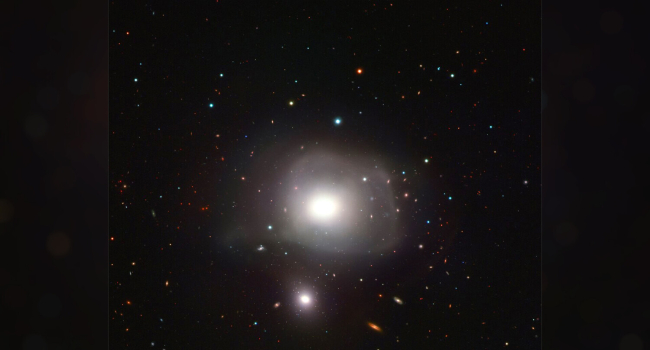
Astronomers from the European Southern Observatory (ESO) have unveiled images of an unusual elliptical galaxy, NGC 3640, located 88 million light-years from Earth. Their research reveals that this galaxy is poised to engulf its nearby companion, NGC 3641.
A Galaxy with a History of “Feasting” on Others
NGC 3640 stands out with its egg-shaped structure and a turbulent past. Scientists have determined that over the past few billion years, it has already consumed several smaller galaxies. Evidence lies in the remnants of ancient stars, which serve as traces of past collisions. These stars act as “fossil markers,” aiding researchers in piecing together the galaxy’s history.
A Collision on the Horizon
The ESO images show that NGC 3641 has not yet undergone significant changes, indicating that the merger process has not yet begun. However, the gravitational pull between the two objects will inevitably draw them together, eventually forming a single, more massive galaxy.
“Galaxies are constantly evolving, swallowing one another and reshaping themselves,” ESO representatives explain.
What This Means for Science
The study, conducted by astronomers from the Italian National Institute of Astrophysics, offers deeper insights into the evolution of NGC 3640 and the dynamics of galactic mergers. Continued observations of this cosmic duo will help scientists better understand the mechanisms behind the formation of large galactic structures and their role in the development of the universe.