make preferable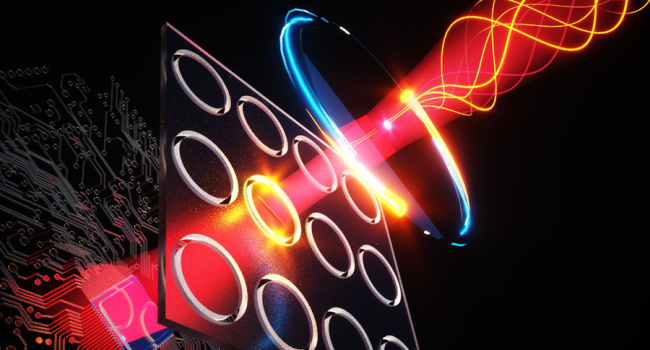
The Massachusetts Institute of Technology (MIT), in collaboration with the University of Minnesota and Samsung, has created a terahertz camera that is cheaper, provides greater sensitivity and speed than previous versions, and can be used in a number of domains.
Until now, it has been difficult for scientists to create a device that can receive images using terahertz waves. Existing devices are quite expensive, slow, have large dimensions, and require vacuum systems and extremely low temperatures.
But now scientists have managed to create a camera that can detect terahertz pulses very quickly, and can do it with high sensitivity and at room temperature and pressure. What's more, the new camera can get real-time information about the orientation, or "polarization," of the waves, which the current devices can't.
Where can it be used?
The paper, published in the journal Nature Nanotechnology, says that terahertz radiation, whose wavelengths lie between microwaves and visible light, can penetrate many non-metallic materials. And due to this very feature, it can be used in a number of domains—for example, for quality control in industry, in airport security services, as well as in communication.
Sang-Hyun Oh, a professor of electrical and computer engineering at the University of Minnesota and a co-author of the project, said that while current versions of terahertz cameras cost tens of thousands of dollars, this system uses CMOS cameras, which are inexpensive, making this system a big step forward towards creating a practical terahertz camera.
The researchers note that there are many ways to further improve the sensitivity of the new camera, although even as it stands the device may still have some potential applications. As for the commercialization potential of the new device, the quantum dots that the camera uses are now cheap and readily available and are used in a variety of techniques, such as in television screens.
Will it be manufactured commercially?
According to Keith Nelson, who participated in the creation of the camera, the production of this camera is quite complicated in practice, but it is also based on already existing microelectronics technology.
According to him, unlike existing terahertz detectors, this camera chip can be completely manufactured using today's standard microchip manufacturing systems. And this means that commercial production of this terahertz camera should be possible at some point—and relatively inexpensive.
Although this camera system is still far from commercial production, MIT researchers are already using the new device in the lab when a way to quickly detect terahertz radiation is needed.
As per Keith Nelson, although terahertz waves could in principle be used to detect some astrophysical phenomena, the waves from the sources will be weak, and the new device is unable to capture such weak signals. He also noted that the team is working on improving its sensitivity.