make preferable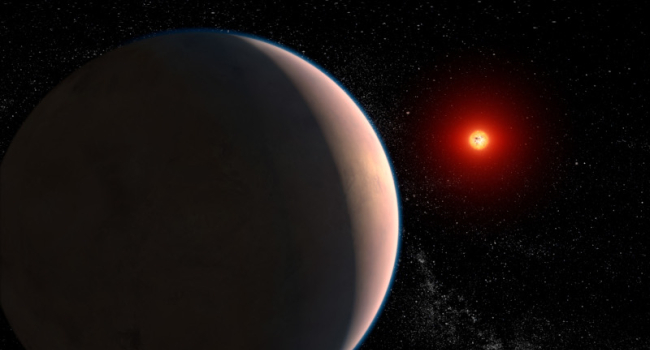
The James Webb Space Telescope has detected signs of water vapor in the atmosphere of a planet called GJ 486 b, 26 light-years away from Earth. If this information is confirmed, this will be the first time that water vapor has been detected in the atmosphere of a rocky exoplanet.
However, for now, scientists are not sure about the reliability of this discovery.
Water vapor is considered one of the most important conditions for the existence of life, or at least a suitable condition for potential life on planets. In the past, space telescopes have already detected such vapor signatures on exoplanets, but they were gas giants like Jupiter that lack a solid surface. If scientists can now confirm that rocky GJ 486 b also has such vapor, it will be an exciting discovery indeed.
GJ 486 b is about 30% larger than Earth, and its mass is three times larger. The gravity on this planet is very strong, in addition, the planet is very close to its star and is in a state of synchronous rotation; it is always day in one part of the planet and night in another. The surface temperature of the planet is about 430 °C. So, most likely, it is not so suitable for life.
Nevertheless, the discovery of water vapor on this planet is of great importance։ as already mentioned, this will be the first detection of water vapor on a rocky planet, and it will also show that such a planet can maintain its atmosphere even under the constant influence of radiation from it’s nearby star.
But the problem is that the signs of water vapor were found when the planet was passing in front of the star, meaning that there is a possibility that the vapor originated not on the planet itself, but from spots on the surface of the star. On the other hand, according to astronomers, no evidence of the presence of such spots on the star has been found yet.