make preferable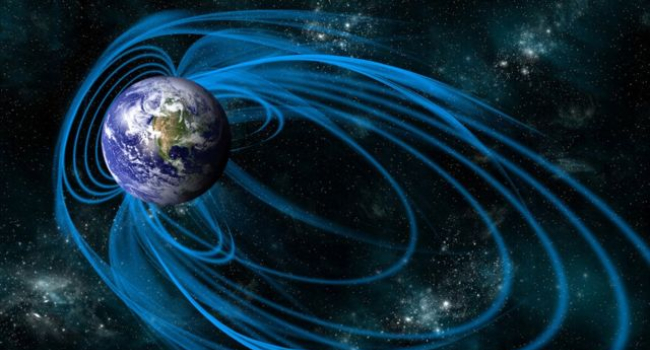
The magnetic field plays a very important role for the Earth and the creatures that live on it: it protects us from solar radiation, affects the climate and weather, besides, thanks to it, the arrows of the working compass point to the north. The planet's magnetic field is also "responsible" for beautiful auroras.
Other planets in the solar system also have magnetic fields. Scientists, however, do not rule out that some much more distant planets may have such fields. Recent observations with the Very Large Array (VLA) radio telescopes in New Mexico have found evidence of a magnetic field on the rocky YZ Ceti b orbiting its star about 12 light-years from Earth. According to research published in the journal Nature Astronomy, this is the first possible detection of a magnetic field on a planet outside the solar system.
"This study not only shows that this particular rocky exoplanet probably has a magnetic field, but also provides scientists with a promising method to find more planets with magnetic fields," said Joe Peske, the study's author and Director of the US National Radio Astronomy Observatory (NRAO).
According to scientists, the planet cannot be habitable without a magnetic field: without that field, particles from the Sun's energy could destroy the planet's atmosphere and deprive it of the gaseous mantle necessary to sustain life. According to Peske, finding potentially habitable or habitable planets in other systems depends in part on being able to determine whether rocky exoplanets like Earth actually have magnetic fields.
YZ Ceti b is not a habitable planet; it is too close to its star for the planet's temperature to be favorable for life. Moreover, the speed of its rotation in the orbit is so great that one year of this planet is equal to two days on Earth. However, scientists managed to detect radio waves from this planet, which most likely originated from the magnetic field of this planet.
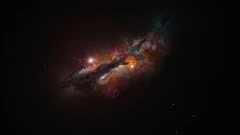
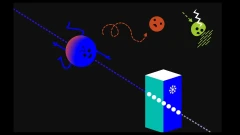
Scientists say the planet's magnetic field pushes electrically charged plasma back toward its star, which then interacts with the star's own magnetic field, releasing bright bursts of energy. Essentially, the radio waves the team observed were an aurora on the star, likely created by an interaction with the planet.
"If this planet has its own atmosphere, it should also have an aurora," said Sebastian Pineda, an astronomer at the University of Colorado Boulder and co-author of the new study.
However, the team of scientists is not 100% sure that the starburst they observed is entirely due to the phenomena taking place in YZ Ceti b. Additional observations are needed to confirm that these phenomena observed by scientists are related to the magnetic field of the rocky planet, and not just to the features of the star itself.
However, the team remains hopeful that these discoveries could be a breakthrough in the search for other habitable planets in the future.