




 make preferable
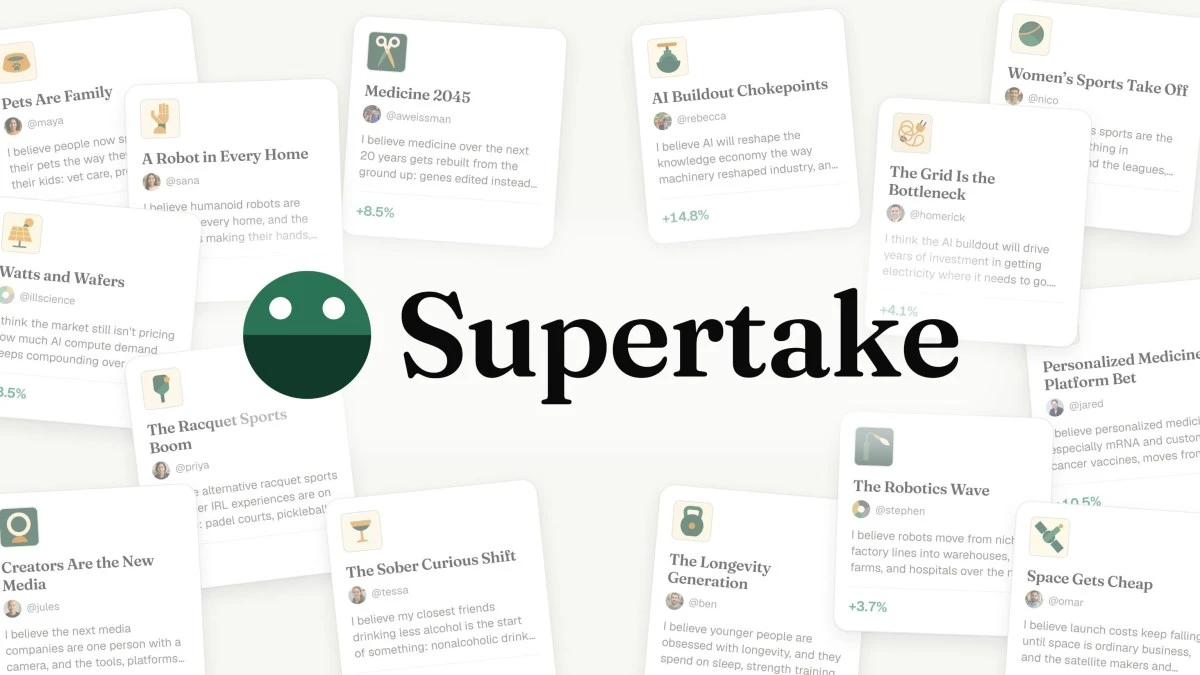
U.S. startup Supertake has raised $20 million in seed funding to turn users' ideas about the future of markets into real investment portfolios. Rather than picking stocks themselves, users describe in plain language what changes they consider likely in the world, and AI helps select assets and manage investments through a connected brokerage account.
The company aims to change the conventional model of automated investment management: decisions will be based not on standard risk-tolerance questionnaires, but on users' personal views on the economy, technology, and social trends.
From a market idea to an investment portfolio
Supertake's process begins with a take — a user's view of how the world might change and what implications that would have for markets. For example, someone might suggest that interest in longevity and enhancing one's appearance will become a mainstream trend. The AI system helps turn that idea into a collection of pharmaceutical and cosmetics stocks that could potentially benefit from such a development.
Users do not simply enter a prompt and receive a ready-made list of securities. The AI interacts with them, refines the initial idea, and helps develop it into an investment strategy. The system then builds a portfolio and can manage it through connected brokerage platforms.
Users' ideas are also published in a ranking on Supertake's website. Other participants who share a particular outlook can invest in the corresponding portfolio.
The service currently works with Coinbase and Robinhood. The company plans to connect additional brokerage platforms in the future.
Who invested in the startup
The $20 million round was led by Adjacent, the venture capital firm headed by Nico Wittenborn. Participants included Coinbase Ventures and Union Square Ventures, as well as several prominent angel investors.
Investors included Meta Superintelligence Labs product head Nat Friedman, Vercel CEO Guillermo Rauch, investor Scott Belsky, and former Coinbase executive Nemil Dalal. Product manager Nikita Bier also joined the round.
Supertake was initially developed within Union Square Ventures. Its founder, Michael Mignano, previously co-founded the podcasting platform Anchor, which Spotify acquired in 2019 for more than $150 million. Following the deal, he led Spotify's podcasting business for several years, then worked as a venture partner at Lightspeed and helped develop other AI projects.
Mignano will remain Supertake's founder and executive chairman, but day-to-day management has been handed over to his fellow co-founders, CEO Lincoln Murr and CTO John Peterson. Both previously worked at Coinbase, where they focused on AI products and infrastructure for interacting with autonomous agents.
How the startup plans to keep AI actions in check
Delegating investment decisions to algorithms requires far more trust than using AI to find information or analyze markets. Supertake therefore says it has a system of safeguards designed to prevent agents from handling money without the owner's oversight.
In particular, the AI cannot independently deposit funds into an account or withdraw them: these transactions require the user's explicit consent. Safeguards include trade-size limits, lists of permitted and prohibited assets, and monitoring of deviations from the specified portfolio allocation. The system is intended to track suspicious activity in real time.
In addition, agents do not receive access to brokerage account credentials. In this way, the developers are trying to separate the ability to analyze and execute authorized trades from direct control over users' money.
Co-founder Lincoln Murr compares the development of agent-based financial services to the adoption of self-driving cars: as the technology improves, people will likely entrust algorithms with more decisions over time. For now, however, this is more of a bet on the future by the company than evidence that users are ready to hand over management of their savings to AI.
Not a prediction market, but a new kind of robo-advisor
Although Supertake's investment ideas are based on assumptions about the future, the company does not consider itself a prediction market platform. The developers draw a distinction between betting on whether a particular event will occur and building a portfolio of assets expected to benefit from an anticipated change.
For now, the service focuses primarily on medium- and long-term investments. In the future, however, the team wants to add more sophisticated instruments: short positions, derivatives, perpetual contracts, and trades with long exposure. Partnerships with companies in the prediction market sector are also being discussed.
Supertake is currently in beta testing, with access available only through a waitlist. The founders say they have already entrusted substantial sums to the system themselves: Murr has invested tens of thousands of dollars, Peterson several thousand, and Mignano hundreds of thousands.
The startup plans to use the new funding round, which follows $2 million in pre-seed investment, to expand its team, including engineers, designers, and marketing specialists.
Supertake's central idea is to make investing an extension of people's personal views of the future, tasking AI with translating those views into specific financial decisions. But the success of this model will depend on more than the quality of its algorithms. Transparency around their actions, the reliability of safeguards, and people's willingness to trust autonomous systems to manage real money will be just as important.