make preferable
Data from the Hubble Space Telescope, collected more than a quarter of a century ago, helped astronomers detect unusual chemical signatures that may point to the existence of a planet formed after its star died. If the hypothesis is confirmed, the finding would become the first candidate for a second-generation planet around a white dwarf — the remnant of a star that has exhausted its nuclear fuel.
The study was published in the journal Nature Astronomy. Scientists suggest that the planet may have formed from material expelled by the star during a late stage of its evolution. This discovery could change ideas about how long planetary systems are able to survive and re-emerge.
A mystery hidden in the Hubble archives
The story of the discovery began with observations of the star HS 0209+0832, which the Hubble telescope carried out in 1999. In the data obtained, researchers found about a hundred chemical signatures that they were unable to identify at the time.
Years later, astronomer Jamie Williams, a graduate student at the University of Warwick in the United Kingdom and the study’s lead author, returned to the archival materials. Using an updated chemical database, he found that many of the mysterious signatures matched niobium — an element that had not previously been detected in other studied white dwarfs.
The amount of niobium and the peculiarities of the system’s chemical composition led scientists to suggest that there may be a planet around the star, formed from material ejected as it faded. “Hubble is showing us something we have not seen before in this white dwarf system: a high abundance of niobium,” Williams said.
How second-generation planets appear
Niobium played a particularly important role in the study. This element and other elements heavier than iron are not formed under ordinary conditions in stellar cores through thermonuclear fusion. Their appearance requires extreme conditions that arise at certain stages of stellar evolution.
According to theoretical astrophysicist Nicholas Stone of the University of Wisconsin–Madison, the presence of niobium may point to processes accompanying the death of the star and the ejection of its material into surrounding space.
Researchers suggest that part of this material, enriched with heavy elements, eventually came together to form a gas planet. The rest of the expelled matter dispersed, but the planet may have survived.
A gas giant next to a white dwarf
To test the hypothesis, the team used not only archival Hubble observations, but also data from the FUSE space observatory, which completed its mission in 2007. These also showed clear signs of the presence of niobium in the HS 0209+0832 system.
Additional information came from NASA’s TESS satellite, which observed the white dwarf for four months. The instrument recorded periodic changes in brightness, indicating the possible orbit of a planet around the star.
The suspected orbit lies about 6 million kilometers from the white dwarf — significantly closer than Mercury’s orbit around the Sun.
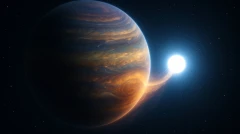
According to the researchers’ estimates, the second-generation planet candidate is a gas giant roughly the size of Jupiter. It is now likely losing its atmosphere rapidly: the young white dwarf remains very hot and emits energy that may be stripping away the planet’s outer layers.
Scientists suggest that the lost material forms a tail resembling a comet’s, and then creates a disk around the white dwarf. Part of the material from this disk may fall onto the star’s surface. Such a process would explain why Hubble detected the characteristic chemical signatures while observing the white dwarf.
Can a planet survive the death of its star?
Despite the loss of material, Williams believes that the proposed planet may continue to exist for a long time. As the white dwarf cools, conditions around it will change, and the system may transition into a more stable state.
The researcher suggests that over time, the planet could end up in the star’s stable habitable zone for millions of years. However, this remains only a hypothesis: the existence of the second-generation planet itself has yet to be confirmed, and its further evolution requires additional study.
Scientists need to determine exactly how such planets form, how often they occur, and how their orbits change after a star turns into a white dwarf. Williams plans to continue observations with Hubble to gather more data and determine how common such systems are.
Study co-author, astronomer Boris Gänsicke of the University of Warwick, emphasizes that the discovery was the result of reanalyzing long-known data and jointly discussing the scientific problem.
If the hypothesis is confirmed, it will show that the history of planetary systems can continue even after the death of the stars that gave rise to them. In that case, the end of an ordinary stellar life cycle would mean not only the disappearance of the former system, but also the possibility of new worlds appearing.