make preferable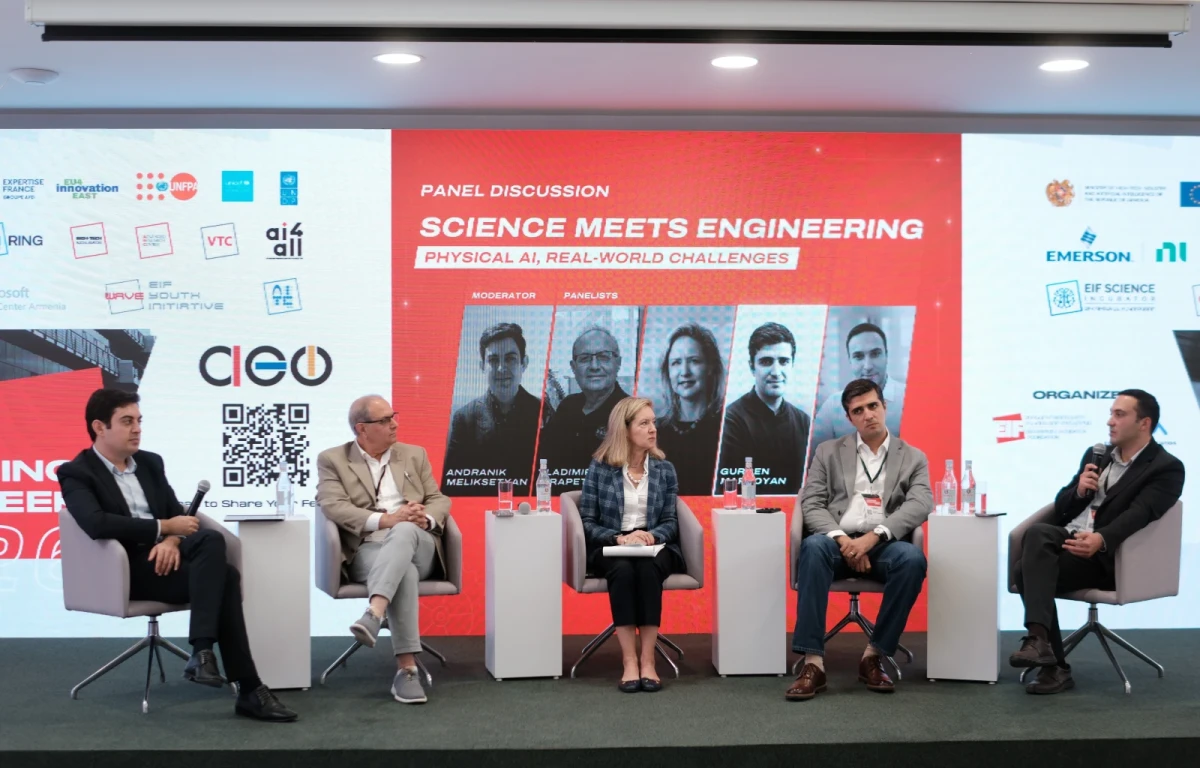
If conventional AI gives a wrong answer, the result can simply be ignored. But if a robot operating in the physical world makes a mistake, the consequences can be very different: the machine may damage equipment, collide with an obstacle, or make a dangerous decision. That is why, for Physical AI, it is not enough to teach a system to “think” — it must understand the physical world, trust its own sensors, and act safely in situations the developers may not even have anticipated.
This very difference became one of the central themes of the discussion on Physical AI during Engineering Week 2026 in Armenia. Participants discussed what prevents artificial intelligence from moving out of the digital environment into robots, industrial systems, and other physical devices — and why success in developing AI models alone is not enough for that.
Robots need more than just programmers
Discussion moderator Andranik Meliksetyan, Principal Solutions Architect at NI Emerson, pointed out an important feature of this emerging field. Physical AI works with the real world. The system receives information from physical objects and must use it to solve a specific engineering problem. This means a developer must understand not only programming and artificial intelligence, but also the engineering system the model is working with.
According to Meliksetyan, software developers are now actively entering robotics, including thanks to the rise of generative AI. But many of them face the need to gain engineering experience.
At the same time, the reverse movement — engineers entering AI — creates a separate opportunity. Specialists who already have a strong understanding of robots, equipment, and physical systems get a chance to apply that experience in a new field.
Meliksetyan himself said that he has been working on Physical AI over the past year and has been able to take his robotics skills to a new level.
Thus, the development of Physical AI is changing the requirements not only for technologies, but also for specialists themselves: at the intersection of AI and the physical world, people who can understand both sides of the problem are especially in demand.
A mistake in the digital world and a robot’s mistake are not the same thing
According to the discussion participants, the key difference between conventional AI and Physical AI is defined by one word — physical.
A chatbot may hallucinate: it gives an incorrect answer, and the user simply ignores it. In the physical world, an error turns into an action.
Gurgen Mardoyan, Head of R&D Armenia at PMI Science, suggested looking at the problem through the lens of accuracy. For non-critical digital tasks, 95 percent accuracy may be acceptable depending on the specific application. But if the system makes decisions independently in the physical world, the issue becomes much more complicated: how many errors are acceptable, and how well must the robot understand reality?
At the same time, Mardoyan believes that demanding absolute infallibility from a robotic system is probably unrealistic. As an analogy, he referred to the discussion around autonomous driving: perhaps the goal is not for the system to never make mistakes, but for its performance to be safer than human behavior under comparable conditions.
This, however, does not eliminate safety requirements. The situation remains especially difficult with dynamically stable robots capable of walking and moving, rather than simply performing operations in a fixed position. According to Mardoyan, this is precisely why the large-scale use of such humanoid systems is still limited.
Thus, the main question is not only whether a robot can be made more accurate, but also what level of errors is acceptable for a particular task.
Simulation is not the same as the real world
Another problem is the gap between how a system behaves in simulation and what happens in practice.
Narek Nazaryan, scientific project lead at the EIF Science Incubator and researcher at Yerevan State University, noted that the real world is nonlinear and has an enormous number of degrees of freedom. Therefore, behavior that looks good in a virtual environment will not necessarily be reproduced in reality.
A robot also has another source of uncertainty — its own sensors.
Cameras and other sensors can get dirty, and equipment can wear out. This means it is not enough for the system simply to receive data from sensors. It must also understand when its own sensors are misleading it.
This is an especially important issue for autonomous systems: a machine must make decisions not only based on incoming information, but also taking into account how much that information can be trusted.
The larger the model, the harder it is to carry around
There is also a very physical limitation.
A powerful model requires significant computing resources and energy. In a data center, that is one kind of problem, but when it comes to a small autonomous robot that must move independently through its environment, the possibilities shrink dramatically.
Nazaryan identified size, weight, and power consumption as a separate Physical AI challenge. The goal is to achieve sufficient computing power while staying within the constraints of the device itself.
Therefore, the development of the field depends not only on improving models. More efficient combinations of hardware and software are needed.
Robots will not get far without connectivity
For autonomous physical systems, infrastructure beyond the robot itself is also important.
Shane Tews, president of Logan Circle Strategies and nonresident senior fellow at the American Enterprise Institute, highlighted network development separately. According to her, without connectivity many Physical AI technologies will not be able to operate far enough from their base infrastructure.
The transition from current network capabilities to the next generations of communications will require new investment. And the issue is not simply about data transmission speed. For physical systems, connection reliability, sufficient bandwidth, and minimal latency are critically important.
Tews gave a бытовой example: in the hotel where she was staying, the light in the shower would not turn on because the sensors had been installed incorrectly. In an ordinary situation, this is simply annoying for a person. But a similar problem in an automated physical system can become a matter of trust in the technology.
If people are not confident that the system correctly perceives the surrounding environment and consistently receives the data it needs, bringing it out of the lab and into the real world will be much more difficult.
The hardest task is a situation no one anticipated
The problem becomes even deeper when a robot encounters circumstances that were not part of its prior experience.
Nazaryan noted that a standard language model works in a digital environment, whereas Physical AI must interact with reality. That is why one question is especially important: how will the system behave in a situation it has never encountered before?
This is where the issue of so-called world models arises — models of the surrounding world. They may have a certain degree of correspondence to reality, but, as Mardoyan noted, it is impossible to expect a model to possess one hundred percent accuracy in describing all the world’s physical parameters.
Vladimir Hayrapetyan, senior astrophysicist at NASA GSFC/SEEC, proposed one possible way to increase the robustness of such systems: creating several autonomous devices capable of interacting with one another.
As an example, he mentioned future systems for work on the Moon or in space: several small rovers could have autonomous systems and communicate with a single central node. If one system encounters a problem, information passed through this node could be used to correct operations.
In other words, the robustness of Physical AI can be built not only around the ability of an individual robot to make the right decision, but also around the interaction of multiple systems.
Who is responsible if a robot makes a mistake?
Technical problems are gradually moving into an area where engineering solutions alone are no longer enough.
Nazaryan called safety and regulation among the most important Physical AI challenges. According to him, humanity is creating systems capable of making decisions and acting independently, without human approval at every step.
This gives rise to a whole range of questions.
If a robot is constantly learning and changing its behavior, how should it be classified? Who is responsible for the consequences of a harmful decision — the owner, the manufacturer, or the operator? And how can the safety of a system be verified in scenarios it has never encountered before?
Moreover, regulation here must develop alongside engineering and science. Rules that evolve too slowly may leave people without the necessary protection, but excessively rigid restrictions can slow the development of the technology.
A robot must also be taught to inspire trust
There is also a problem that cannot be solved only with a new processor, sensor, or algorithm.
People themselves will have to get used to machines that act independently.
Meliksetyan noted a paradox of modern robotics: what seems elementary to a human can be a very difficult task for a robot. That is why people often automatically expect human behavior from a humanoid machine: if it looks like a person, the question arises why it cannot do the same things a person would do.
But outward resemblance does not mean identical capabilities.
Therefore, the spread of Physical AI will require not only technical work, but also a kind of change management — explaining to people what such systems can do, what they still cannot do, and why they act the way they do.
According to Meliksetyan, a robot should be perceived not as a toy, but as a real assistant. But that requires trust.
Can a robot have imagination?
In the final part of the discussion, Hayrapetyan raised an even more fundamental question — the ability of a system to act in a situation for which it has no pre-prepared solution.
A human uses accumulated experience to connect different kinds of knowledge and create new ideas. Hayrapetyan called this ability imagination and suggested that reproducing it may turn out to be one of the most difficult challenges for Physical AI.
As long as a robot operates in a well-described environment, an engineer can define many possible scenarios in advance. But the more complex and less predictable the environment becomes, the more important it is for the system to be able to find a solution to an unfamiliar situation on its own.
This is where one of the most important boundaries of today’s robotics lies: it is not enough for a robot to know how the world works. It must be able to act in a world that does not always behave the way the developer expected.
That is why Physical AI has turned out to be a much broader challenge than simply combining artificial intelligence with robots. It is simultaneously a problem of engineering, computing, sensors, connectivity, safety, regulation, and human trust. And, judging by the discussion, many of these questions still lie not in the realm of ready-made solutions, but in the realm of open research.