make preferable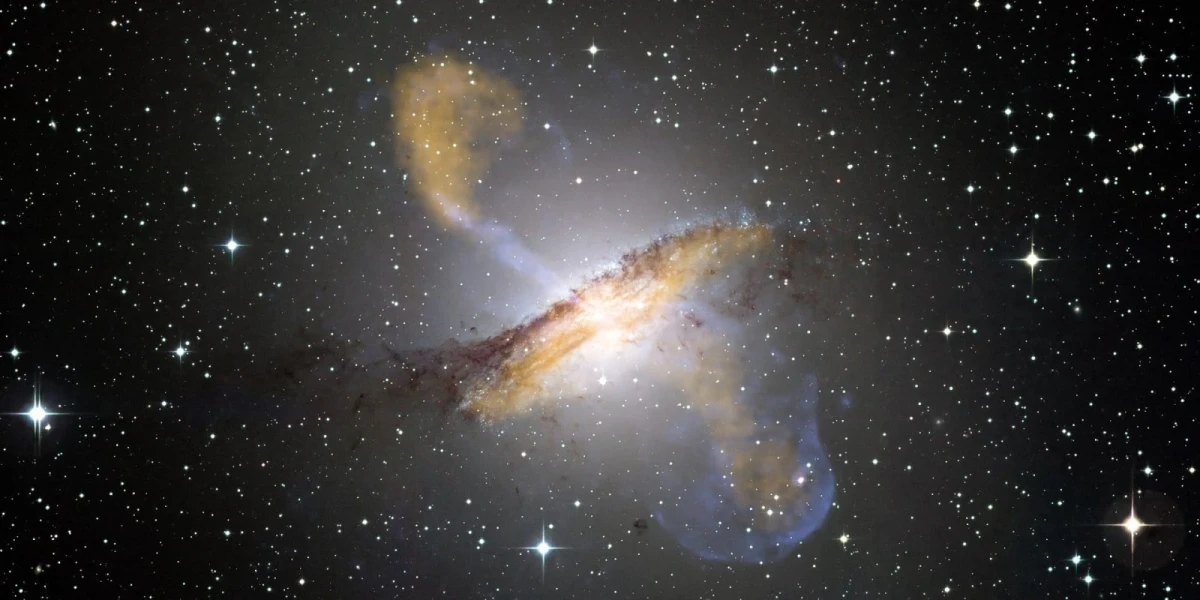
Astronomers have found signs that supermassive black holes can affect gas far beyond the visible parts of galaxies. Narrow streams of superheated plasma — jets — stretch across hundreds of thousands of light-years and leave behind a glowing trail of ionized hydrogen along their path, according to Sciencedaily.
This may explain one of the mysteries of galaxy evolution: why, despite the enormous gas reserves surrounding them, many galaxies eventually stop actively forming stars. The study by scientists from Arizona State University and the Raman Research Institute was published in Astrophysical Journal Letters.
Galaxies are surrounded by a vast supply of material for new stars
Every star begins with cold, dense gas. Large galaxies, including the Milky Way, are surrounded by a giant reservoir of such matter — the circumgalactic medium, or CGM.
It extends roughly 10 to 20 times farther than the visible part of the galaxy. Over time, the gas can cool, move inward, gather into dense clouds, and become the raw material for the birth of new stars.
A natural question arises: if there is so much potential stellar fuel around galaxies, why aren’t stars forming much more actively?
Astronomers have long suspected that some mechanism prevents a significant fraction of this gas from cooling enough and falling back into the galaxy. The new study points to one possible mechanism — the activity of supermassive black holes.
A tiny black hole affects a region thousands of times larger than itself
When a supermassive black hole actively consumes surrounding matter, it can release an enormous amount of energy. Part of that energy is directed into space in the form of narrow jets of superheated plasma.
At the same time, the black hole itself is vanishingly small compared with the galaxy. A supermassive black hole may be comparable in scale to the Solar System, while its galaxy contains about 100 billion stars.
“The amazing question is this: how can something so small have such an energetic impact on something so enormous?” says study co-author Namrata Roy.
The new observations offer insight into how this happens.
Astronomers searched for a glow along the jets
The researchers studied galaxies with active black holes ejecting powerful jets. These flows of hot, fast-moving plasma can extend far beyond the visible part of a galaxy and penetrate the CGM.
The scientists looked for signs that the jets change the state of the surrounding gas. To do this, they observed radiation from ionized hydrogen, in particular the H-alpha line.
For an individual galaxy, such a signal is too weak, so the researchers combined data from hundreds of galaxies with active jets. They used optical observations from the Dark Energy Spectroscopic Instrument (DESI) and radio emission data on the jets from the LOFAR Two-meter Sky Survey (LoTSS).
The result was surprising precisely because of its directionality. If the gas around galaxies is averaged over all directions, the H-alpha signal remains weak. But along the axes traced by the radio jets, the glow becomes significantly stronger.
This suggests that a jet does not simply illuminate the surrounding space evenly. It acts more like a directed beam that ionizes gas directly along its path.
A black hole’s influence reaches the edge of the circumgalactic medium
The researchers detected especially bright ionized hydrogen emission in two regions.
The first is located relatively close to the galaxy — where the jet first collides with the circumgalactic medium. The second lies much farther away, near the outer edge of the CGM. According to the data, this is where the jet may transfer a significant part of its energy to the surrounding gas.
Thus, the black hole at the center of a galaxy is capable of transmitting energy across distances of hundreds of thousands of light-years.
“What strikes me most is the scale of this connection,” Roy says. “The black hole is incredibly small compared with the galaxy, but its influence can reach hundreds of thousands of light-years, far into its outer regions.”
At the same time, the researchers found important confirmation of their interpretation. They studied magnesium as an indicator of colder gas. Unlike H-alpha, its distribution turned out to be much more uniform and was not linked to the direction of the jet.
This suggests that cold gas is already present around the galaxy as a relatively uniform reservoir. And as the jet passes through it, it locally heats and ionizes the matter, causing it to glow in H-alpha.
Jets may deprive galaxies of fuel for new stars
This is where the observed effect may be connected to a galaxy’s long-term fate.
If jets heat, stir, and disturb the gas in the CGM, it becomes harder for that gas to cool and fall back into the galaxy. And without a steady inflow of cold gas, the galaxy has less material available to form new stars.
In this way, an active black hole could potentially act as a kind of brake on star formation. On long timescales, its activity may help drive a galaxy into a quiescent state in which new stars are born much more slowly.
In that case, the black hole affects not only the immediate surroundings from which it itself draws matter. Its energetic impact extends across the enormous region surrounding the entire galaxy.
Direction turned out to be decisive
Previous studies had already tried to find similar signals, but did not always detect them. The new work suggests that the reason may have been the search method.
If one assumes that circumgalactic gas is distributed and behaves the same in all directions, the effect of the jets is easy to lose amid the faint overall signal. Instead, the researchers compared the gas along the direction of the jets with the rest of the CGM.
It was precisely this observational orientation that made it possible to see the characteristic signature: hydrogen becomes brighter exactly where streams of plasma from the black hole pass through it.
The study also shows how useful it can be to combine different types of data. Optical observations from DESI and radio measurements from LoTSS made it possible to connect the gas glow with the direction of the jets and to see an effect that is almost impossible to detect in a single galaxy.
Now this result gives astronomers a new way to study how supermassive black holes interact with their galaxies and to test models explaining why some galaxies continue forming stars while others gradually fade into quietness.