make preferable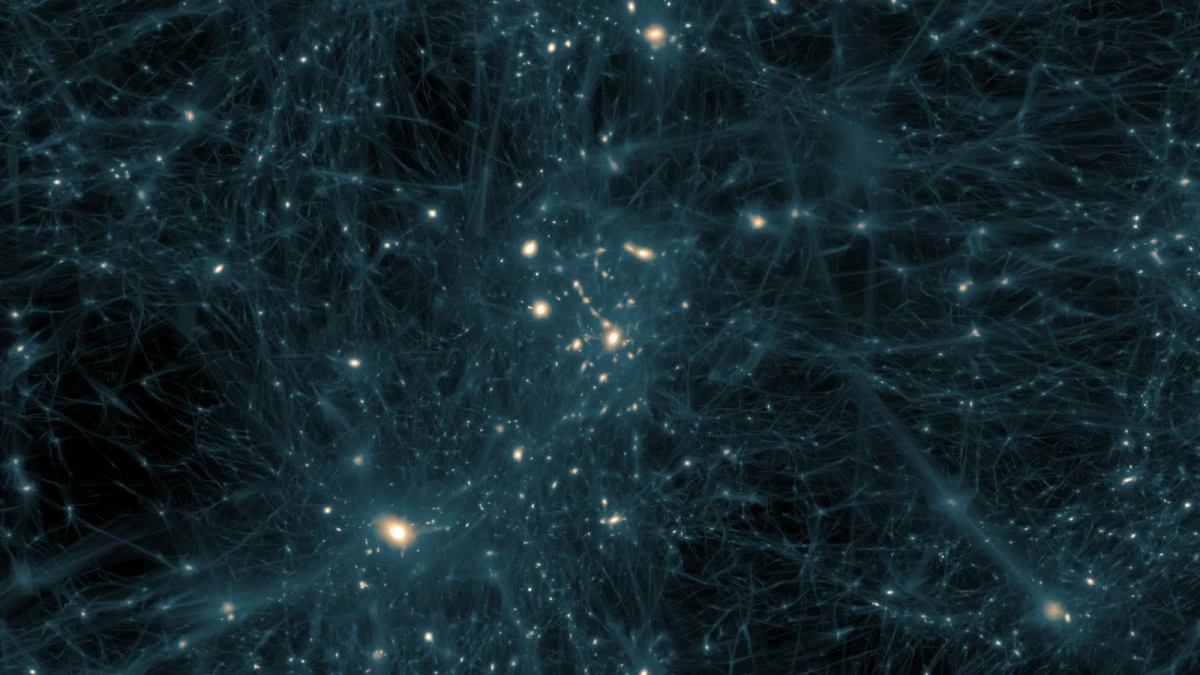
Physicists have proposed an unusual way to obtain possible dark matter particles — not to detect them in space or in an underground detector, but to try to create them directly in a particle accelerator. According to a new theoretical study, fast atomic nuclei can “shake” the quantum vacuum and turn its fluctuations into real particles — hypothetical axions.
The study by scientists at the Helmholtz Center in Dresden was published in Physical Review D. For now, this is only a theoretical proposal, but the authors believe that, in principle, it can be tested using existing accelerators.
The empty vacuum is not actually empty
In classical physics, a vacuum can be thought of as a space from which all matter has been removed. In quantum physics, the picture is far more complex: even in the state of minimum energy, quantum fields continue to undergo fluctuations.
The researchers propose using these fluctuations as a source of particles. The idea is based on the dynamical Casimir effect — a phenomenon in which changing the conditions for quantum fields can lead to the appearance of real particles.
If an atomic nucleus moves with sufficiently great acceleration, it can interact with the quantum vacuum in such a way that the energy of its fluctuations is converted into particles.
Another unusual quantum effect appears here as well — the Unruh effect. For an observer moving with acceleration, the ordinary vacuum may appear as a medium with temperature, filled with particles. Within the proposed mechanism, this creates conditions under which axions can emerge from the vacuum.
Why the focus is specifically on axions
Axions have not yet been detected experimentally. These are hypothetical ultralight particles considered one of the candidates for dark matter.
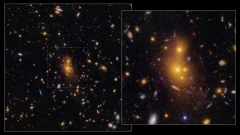
Dark matter is believed to make up a significant fraction of the matter in the Universe, yet it cannot be observed directly: it does not emit light and, as far as is known, interacts only very weakly with ordinary matter. Its existence is inferred primarily from its gravitational influence on stars, galaxies, and the large-scale structure of the Universe.
The search for axions is being carried out in several ways at once — from experiments in deep underground laboratories to observations in space and experiments at accelerators.
Axions may appear in near-grazing collisions
Of particular interest in the new study are heavy-ion collisions. The authors consider a situation in which two nuclei pass very close to each other but hardly collide at all — so-called grazing collisions.
In such a process, the strong acceleration of the nuclei may create suitable conditions for interaction with the quantum vacuum. Calculations show that, as a result, pairs of axions may be produced, and the particles in each pair should be in a quantum-entangled state.
This is important not only from a theoretical point of view: if the mechanism works exactly this way, then testing it would not, in principle, require building an entirely new type of facility. The authors suggest that the approach could be investigated using existing heavy-ion accelerators.
No one has yet “created” dark matter
However, a real experiment is still a long way off. The paper describes a theoretical mechanism, not the observed production of axions. Physicists have not yet observed these particles themselves either.
Therefore, it is still premature to talk about creating dark matter in the laboratory. The researchers have proposed a way to test one of the hypotheses about the nature of dark matter — using not some unknown substance, but the fundamental properties of the quantum vacuum itself.
If such experiments someday confirm the model’s predictions and detect axions, this will simultaneously provide evidence in favor of one of the candidates for dark matter. For now, however, “creating dark matter from emptiness” remains a striking but strictly theoretical possibility.