make preferable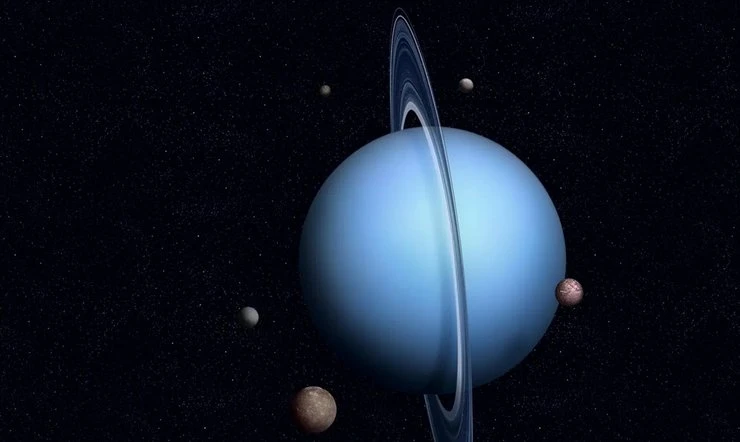
Uranus is the only planet in the Solar System that seems to roll along its orbit. Its axis of rotation is tilted by about 98 degrees, so over the course of a year the planet does not so much spin around its axis as resemble a ball rolling across a surface.
Astronomers still do not know why Uranus ended up in this position. For a long time, one of the main explanations was a giant collision in the early stages of the Solar System’s existence. But there is another scenario: Uranus may have gradually “tipped over” under the influence of an enormous moon that no longer exists today.
Simulations show that such a moon could have slowly moved away from the planet, rocking its axis of rotation, and then, because of the resulting instability, crashed into Uranus. In this case, the collision itself was probably not the main source of the tilt — the bulk of the work may have been done by the moon’s gravity long before the catastrophe, Space.com reports.
Uranus really does rotate almost on its side
For most planets in the Solar System, the axis of rotation lies relatively close to perpendicular to the plane of their orbit.
Earth’s tilt is about 23.5 degrees. It is this tilt that causes the смену времен года: during the year, different hemispheres receive different amounts of sunlight.
With Uranus, the situation is completely different. Its tilt is about 98 degrees.
Because of this, the planet’s seasonal cycle looks extremely unusual. Uranus completes one orbit around the Sun in about 84 Earth years. That means each of its poles receives nearly a quarter of a Uranian year of direct sunlight — about 21 years. Then comes an equally long period of winter.
During the equinoxes, by contrast, the Sun illuminates the equatorial region almost directly.
This creates one of the most unusual climate geometries in the entire Solar System.
It is possible that Uranus was not “tipped over” by a single blow
The most obvious explanation for such a tilt is a collision with a fairly large celestial body.
In the first hundreds of millions of years of the Solar System’s existence, the planets formed in a much more chaotic environment where major collisions were common. Theoretically, a sufficiently powerful impact could have changed Uranus’s orientation.
But this idea has competitors.
Some models show that to produce the current tilt, it is not necessary to assume one giant impact. The planet’s orientation could have changed gradually under the influence of gravitational interactions with other objects.
And a particularly interesting version was proposed in 2022 by astronomers led by Melaine Saillenfest of the Paris Observatory.
Instead of a giant planet, they considered a large ancient moon of Uranus.
How a moon could tip an entire planet
At first glance, the idea seems strange. How could a comparatively small moon change the orientation of a planet’s axis?
The answer has less to do with the force of a single collision than with prolonged gravitational influence.
According to the researchers’ calculations, if a sufficiently massive moon gradually moves away from Uranus, the precession frequency of its axis of rotation changes — that is, the rate at which the axis itself slowly changes direction in space.
At some point, this frequency may coincide with the precession frequency of Uranus’s orbital plane or with one of its related harmonics.
A resonance arises.
After that, the moon and the planet’s axis of rotation begin to interact especially effectively. As the moon continues to move farther away, Uranus’s tilt can increase more and more.
As a result, the planet can gradually approach a position in which its axis becomes almost parallel to the orbital plane.
In other words, Uranus may not have been “knocked over” by a single blow. Perhaps it was slowly rocked for millions of years.
At 90 degrees, things became even more interesting
There is one problem: Uranus’s current tilt is not 90 but about 98 degrees.
The mechanism involving a migrating moon explains well how the planet could approach 90 degrees. But to cross that mark and reach its present position, an additional stage is needed.
According to models by Saillenfest and his colleagues, as the system approached 90 degrees, the moon’s orbit could have become unstable.
The system’s motion during this period became chaotic, and the tilt of Uranus’s axis may have started to change unpredictably. In some simulations, it crossed the 90-degree mark and reached about 98 degrees — almost exactly the value observed today.
After that, the ancient moon could ultimately have collided with Uranus.
But there is an important nuance here: the researchers do not believe that the moon’s impact itself flipped the planet over.
According to Saillenfest, the hypothetical moon was too small for the collision itself to noticeably change Uranus’s axis of rotation. Its role in the scenario lies primarily in long-term gravitational influence. However, for the whole model to work, the moon must eventually disappear — otherwise, we should still be able to see it today.
Where to look for traces of the vanished moon
If such a moon really existed, it could have left behind several indirect traces.
The first is connected with Uranus’s modern moons. The researchers suggest checking how quickly they are moving away from the planet.
If observations show that the moons are moving outward by several centimeters per year, this would mean that significant energy dissipation is occurring inside Uranus. Such a mechanism could have allowed the ancient moon to travel a huge distance from the planet and play a role in changing its tilt.
Moreover, the present-day moons could theoretically be a second generation of moons — fragments that appeared after the destruction of an ancient large moon.
These fragments then gradually spread out into their current orbits.
The age of the moons may also reveal Uranus’s past
There is also a second way to test the hypothesis — to determine the age of the current moons.
Existing estimates allow that they may be almost as old as the Solar System itself. But these estimates still remain uncertain.
If future studies show that Uranus’s moons are significantly younger than the Solar System, this will become indirect evidence in favor of the scenario involving the destruction of an older moon.
Then the following story might begin to emerge.
Once, a large moon orbited Uranus. It gradually moved away from the planet, interacting with its rotation and increasingly amplifying the tilt of its axis. As it approached 90 degrees, the system became unstable. The moon eventually broke apart or collided with Uranus, and its remnants may have formed a new generation of small moons.
Uranus itself was left rotating almost on its side.
Why this mystery is still far from solved
For now, this remains a hypothesis, not an established history of Uranus’s origin.
Observations of the current moons and more precise estimates of their age may provide important clues. It would be especially interesting to detect an unexpectedly high rate at which they are moving away from the planet, or evidence that they formed significantly later than Uranus itself.
But many other questions remain. It is necessary to understand how realistic the existence of a moon with the required mass would have been, whether it could have traveled the needed distance, and whether Uranus’s internal structure is really capable of dissipating enough energy for such a long process.
That is why Uranus remains one of the strangest planets in the Solar System not only in appearance. Its position may be the result not of one catastrophic event but of a complex gravitational history stretched out over an immense span of time.
Perhaps Uranus did not simply receive one powerful blow long ago.
Perhaps it was first slowly rocked for millions of years by a moon that no longer exists today.