make preferable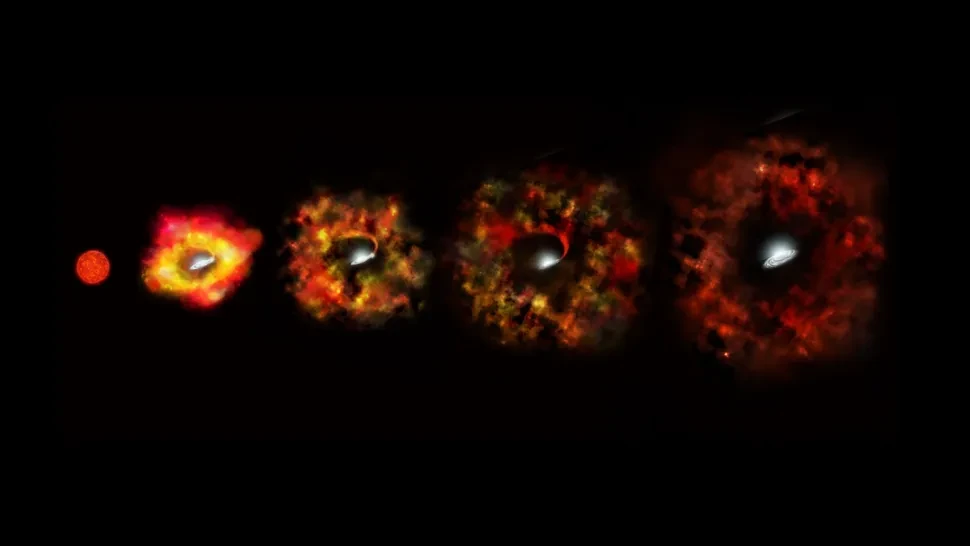
Physicists have found a possible explanation for one of the main mysteries surrounding the death of massive stars: why some end their lives as supernovae and leave behind neutron stars, while others collapse into black holes without a noticeable explosion. According to a new study, a key role may be played by neutrinos’ ability to change their type.
Neutrinos interact only very weakly with ordinary matter, but during the collapse of a stellar core they are produced in enormous quantities. Researchers suggest that changes in their behavior could significantly affect the heating of matter around the core and thereby determine the fate of the entire star, Space.com reports.
Nearly all the energy of the collapse goes into neutrinos
When a massive star exhausts the fuel for thermonuclear reactions, the pressure that had supported it against its own weight weakens. The core begins to contract rapidly. At extreme temperatures and densities, protons and electrons combine to form neutrons, and in the process an enormous number of neutrinos is released.
These particles are often called “ghostly” because they interact extremely weakly with matter. However, during collapse their numbers become so great that some of them collide with the matter around the core and transfer energy to it.
It is this process that may prove critical. If the heating is sufficient, the star’s outer layers may be blown off in a powerful supernova explosion, leaving a neutron star in place of the core. If no explosion occurs, the continuing collapse may lead to the formation of a black hole.
“Neutrinos are not a secondary detail of supernovae. They carry away about 99% of the energy released during core collapse, and a small change in their behavior can determine the fate of the entire star,” noted study co-author Mariam Gogilashvili of the Niels Bohr Institute at the University of Copenhagen.
Neutrinos can change “type”
There are three types, or flavors, of neutrinos: electron neutrinos, muon neutrinos, and tau neutrinos. In 1998, physicists discovered that these particles can transform into one another — a phenomenon known as neutrino oscillations. This discovery earned the 2015 Nobel Prize in Physics.
For the fate of a dying star, this may be especially important. Electron neutrinos interact with ordinary matter much more actively than muon and tau neutrinos. Therefore, changes in the balance among the different types of particles can affect the amount of energy transferred to the matter around the collapsing core.
For a long time, it was believed that such an effect was too small to noticeably alter the process of a supernova’s birth. However, inside a collapsing star the concentration of neutrinos becomes so high that they begin interacting not only with matter, but also with one another. This creates additional conditions for changing their types.
Stars with masses of 16–30 Suns turned out to be especially vulnerable
Researchers modeled the collapse of 195 stars with masses ranging from 9 to 120 solar masses. In their calculations, they used different assumptions about where and how neutrino type changes occur inside the core.
The result was unexpected: accounting for neutrino oscillations may make some massive stars significantly less likely to explode. Instead of producing a supernova and a neutron star, they are more likely to continue collapsing and turn into black holes.
Stars with masses of roughly 16 to 30 Suns proved especially sensitive. In standard models, many of them explode rather easily, but after accounting for neutrino type changes, a significant fraction of such stars no longer reaches the supernova stage.
“What surprised us most was that stars with masses from 16 to 30 solar masses turned out to be especially sensitive to neutrino physics. Many of them explode without difficulty in standard models, but once neutrino type changes are taken into account, that no longer happens,” said co-author Irene Tamborra.
This may explain disappearing stars and the shortage of supernovae
If the conclusions are confirmed, neutrino physics could help explain several cosmic mysteries at once.
Astronomers observe fewer supernovae than some theoretical models predict. One possible explanation is that some massive stars do not explode at all: their cores collapse directly into black holes.
This may also be connected to the mystery of disappearing red supergiants. Observations show that some very massive stars seem to vanish without leaving behind the expected supernova. One possible scenario is direct collapse into a black hole.
Neutrino type changes may also affect the properties of the neutron stars that form. According to the researchers’ calculations, this process may lead to the formation of less massive neutron stars, which could potentially be consistent with observations of objects with masses below some earlier theoretical estimates.
The next step is three-dimensional models
For now, the results are based on modeling and require further verification. The researchers plan to move on to more realistic three-dimensional calculations in which neutrino flavor changes will occur directly over time as the star collapses.
Such models should show how strongly neutrino oscillations affect the actual explosion mechanism and under what conditions a star shifts from the supernova scenario to black hole formation.
If the effect is confirmed, neutrinos will turn out to be not just a byproduct of a massive star’s death, but one of the factors capable of determining its ultimate fate.