make preferable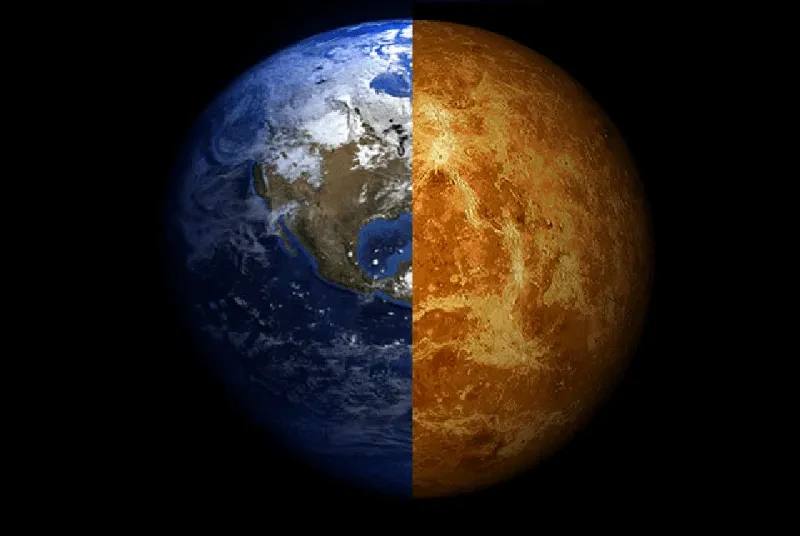
Earth and Venus are similar in many ways: both planets are nearly the same size and mass, consist primarily of rocky material, and have metallic cores. Yet today, they are two completely different worlds. Earth possesses a powerful global magnetic field that shields it from the solar wind, whereas Venus has virtually no such field. Why did two similar planets arrive at such radically different outcomes?
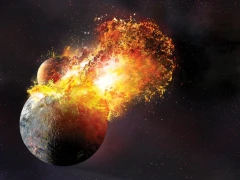
One possible answer is linked to an event that occurred during the earliest stages of Earth's formation. This was a giant collision with a body roughly the size of Mars, which, according to a widely accepted hypothesis, led to the formation of the Moon. Researchers have suggested that this impact might have done something else for Earth: stirred its core and thereby created the conditions necessary to launch a planetary "dynamo" that generates a magnetic field.
Why Venus was left without a magnetic field
A planet's magnetic field does not arise on its own. Generating it requires the movement of a conducting fluid within the core. On Earth, this "engine" is the liquid outer core, which is rich in iron. The movement of material inside it creates electric currents, which in turn sustain the global magnetic field.
With Venus, the situation is more complex. Based on its density, scientists assume that the planet, like Earth, has an iron-rich core, with a significant portion of it remaining in a molten state. Therefore, the lack of a magnetic field cannot simply be explained by an absence of liquid metal inside Venus.
For a long time, Venus's extremely slow rotation was considered a primary suspect: one full turn on its axis takes about 243 Earth days. Later, however, researchers shifted their focus to another issue—how efficiently Venus removes heat from its interior.
For a liquid core to remain actively convective, heat must escape outward. On Earth, plate tectonics aids this process: the movement of plates helps transport heat from the deep interior to the surface.
Venus lacks global plate tectonics. Consequently, its mantle may remove heat from the core far less efficiently. If insufficient heat leaves the core, the required convection—the large-scale movement of molten metal—fails to occur. And without it, the planetary dynamo cannot function.
This is how the fate of Venus might have looked: a liquid core exists, but its movement proved insufficient to generate a global magnetic field.
However, another possibility exists—the problem could have originated even earlier, during the formation stage of the planet itself.
An "onion" inside a young planet
When Earth and Venus were first forming, they grew by colliding with huge numbers of smaller bodies. As material accumulated, heavy metals—primarily iron—sank to the center of the molten planet and formed the core.
Yet the core of a young planet might not have been as homogeneous as commonly pictured today. Along with iron, other elements sank into it—including oxygen, silicon, and sulfur. They could have separated by density and chemical composition, forming several stable layers within the core.
Researchers led by Seth Jacobson proposed that, in such a scenario, the core might have acquired a layered structure—metaphorically speaking, an "onion" structure. Inside each individual layer, material could mix, but the boundaries between layers prevented full-scale mixing of the entire core. As a result, heat would be transferred outward relatively slowly, and large-scale circulation of molten metal would not occur. Consequently, no magnetic dynamo would form.
If this model is correct, Venus may have been set on a path toward a planet without a global magnetic field from the very beginning.
What happened to Earth then?
This is where the Moon enters the story again. According to the hypothesis by Jacobson and his colleagues, Earth experienced a colossal impact with a Mars-sized body during the late stage of its formation. It is this event that is credited with forming the Moon.
For Earth itself, however, the consequences may have been far deeper than just acquiring a satellite. The impact was powerful enough to disrupt the existing layered structure in the core and mix its various components. Instead of several relatively isolated layers, a more homogeneous core was formed.
After that, nothing hindered large-scale convection. The molten iron gained the ability to move actively, heat began escaping more efficiently from the core into the mantle, and further heat transport to the surface was eventually sustained by geological processes, including plate tectonics. Thus began the mechanism that maintains Earth's magnetic field to this day.