make preferable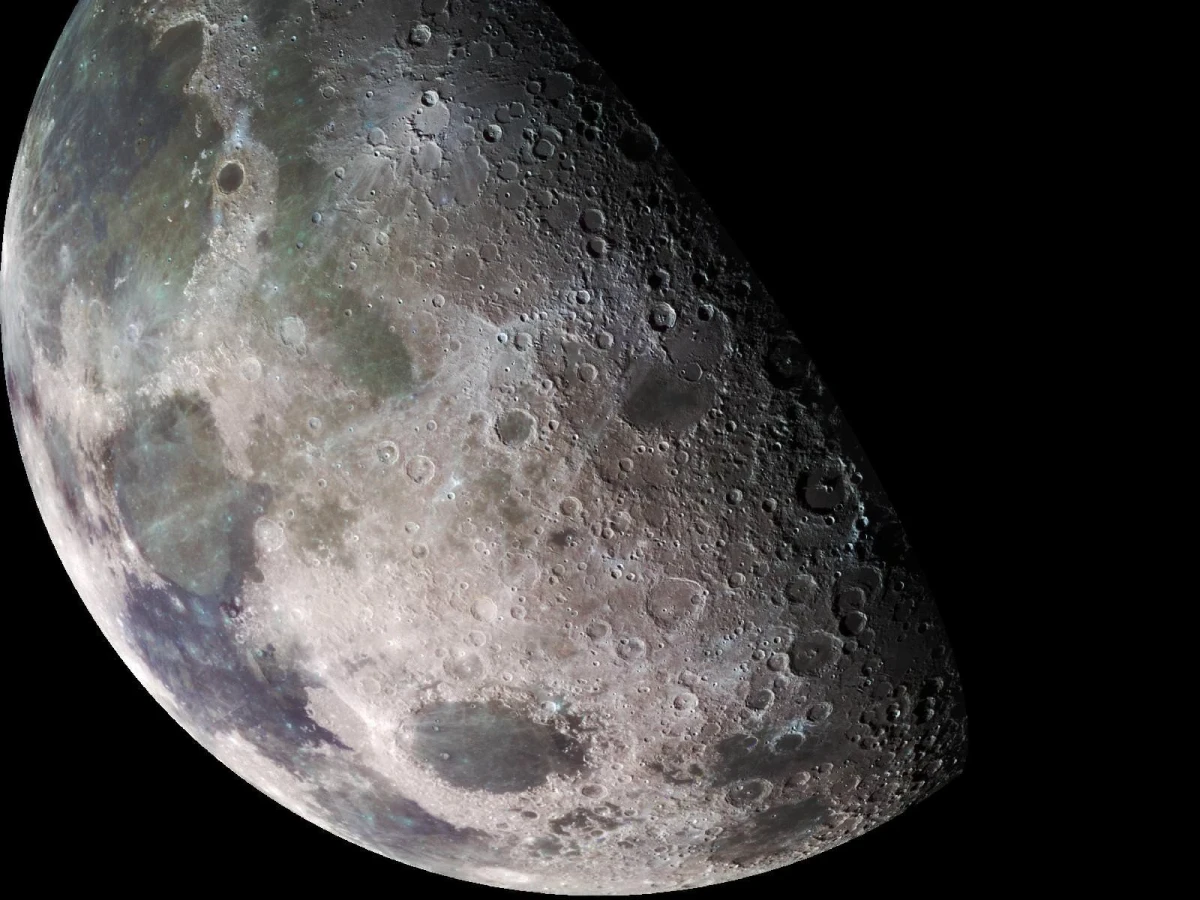
Scientists propose searching the Moon not for radio signals, but for tiny artificial particles that may have arrived there from interstellar space billions of years ago. The researchers emphasize that there is currently no evidence of extraterrestrial technology, but this hypothesis can already be tested experimentally.
The lunar surface may have preserved an ancient cosmic “archive”
The idea comes from researchers affiliated with the SETI Institute. In August, a paper devoted to the search for so-called microscopic technosignatures was published on arXiv. The article has not yet been peer-reviewed and is being considered for publication in the International Journal of Astrobiology.
The authors propose searching the lunar regolith for extremely small artificial particles — a kind of debris that technological civilizations could theoretically have left behind. These would not necessarily be intentionally created messages: they could be durable fragments of materials produced as a byproduct of space exploration or large-scale engineering projects.
“For billions of years, the Moon has quietly accumulated material from space, and a significant portion of it is probably older than the Moon itself,” said study leader Lewis Pinault.
It is precisely the lack of active geology that makes the lunar surface interesting for such a search. On Earth, water, the atmosphere, and tectonic processes constantly mix and destroy ancient materials. The Moon has no flowing water or dense atmosphere, and its surface changes very little on the scale of human history. Therefore, the regolith could potentially preserve particles that arrived there a very long time ago.
How alien technology could have ended up on the Moon
The hypothesis suggests that artificial particles could travel between star systems along with interstellar dust. If some technological civilization existed long before humanity and produced sufficiently durable microscopic materials, a small fraction of them could theoretically have escaped their home system.
Over time, such particles could have crossed interstellar space and settled on the Moon’s surface. As a result, the lunar regolith might contain a kind of material trace of civilizations that existed long before humans appeared.
The researchers intend to investigate whether such a scenario is possible at all: whether such particles could survive for vast spans of time, travel across interstellar distances, and become embedded in lunar soil.
For the search, they propose using several methods at once — from microscopy and materials analysis to computer vision using artificial intelligence.
They want to start with just one cubic meter of soil
The proposed scope of the study is relatively small — about one cubic meter of lunar regolith, or roughly 35 cubic feet. That is comparable in volume to a large refrigerator.
Scientists want to examine such a sample thoroughly using different instruments and determine whether it contains particles with characteristics that might indicate an artificial origin. Even a lack of findings would be a useful result: it would make it possible to set limits on the amount of durable artificial materials that technological civilizations could have produced over the history of the Milky Way.
At the same time, this is not an attempt to prove the existence of aliens in advance. The study itself has not found any extraterrestrial technology so far. Its goal is to show that this method of searching for technosignatures can be placed on a scientific footing and tested experimentally.
Future lunar missions may provide material for the search
The main practical advantage of this idea is humanity’s return to the Moon. NASA’s Artemis program includes new crewed missions and the delivery of lunar samples, while China’s Chang’e program is already conducting robotic exploration of the Moon and is also considering crewed flights.
This creates an opportunity to obtain new regolith samples and test the hypothesis directly.
This approach differs from the classic SETI search. The institute traditionally looks for signs of intelligent life through artificial radio signals that could come from existing extraterrestrial civilizations. The new work proposes searching for material traces of civilizations of the past — even those that may have disappeared long before humanity emerged.
If nothing unusual is found in lunar dust, the study could still prove useful for understanding the movement of dust through interstellar space, the processes taking place on the Moon’s surface, and the consequences of cosmic collisions. In addition, modern sample-analysis methods make it possible to look for features that could not be detected during the Apollo era.
So for now, this is not about discovering alien technology, but about a new way of searching for traces of it. And for the first time, the idea of testing such a scenario in practice appears to be technically feasible.