make preferable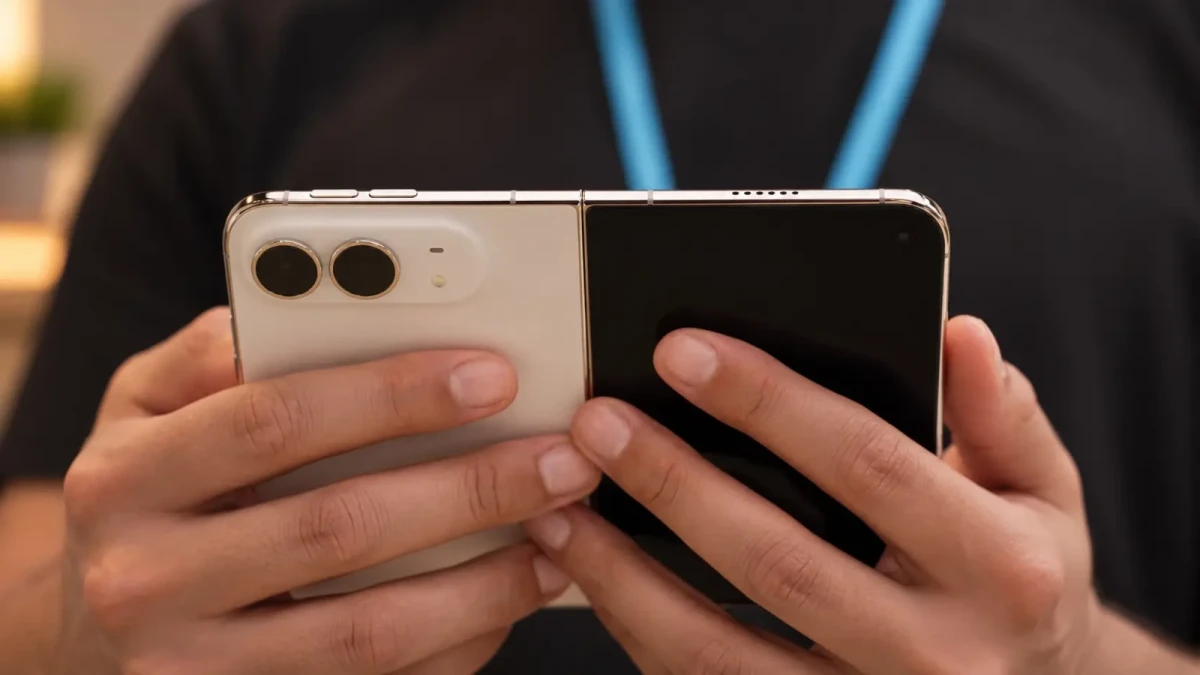
Apple has entered the foldable smartphone market with a form factor unusual for the company: the iPhone Duo opens into a wide display, combining a compact outer screen with an almost square inner one. But the newcomer already has several rivals — although the availability of these models varies greatly by region.
Foldable smartphones can generally be divided into three main types. The first is large book-style devices like the Galaxy Fold, with a tall outer screen and an almost square inner one. The second is clamshell models such as the Motorola Razr, with a small outer display and a tall, narrow screen inside. The third format appeared later: a wide foldable smartphone that occupies a middle ground between the two previous categories.
The iPhone Duo belongs to the latter type. It has a 5.4-inch outer screen and a 7.6-inch inner display with an aspect ratio close to 4:3.
Samsung Galaxy Z Fold8 — the main rival
The most obvious alternative to the iPhone Duo is the Samsung Galaxy Z Fold8. It has a 5.5-inch outer screen and a 7.8-inch inner one with roughly the same 4:3 aspect ratio.
At the same time, Samsung is noticeably more compact and lighter: when folded, it is 9.7 mm thick compared with 11.3 mm for the iPhone Duo, while its weight is 201 g versus 254 g. Inside is a 4800 mAh battery, whereas Apple has not yet disclosed the iPhone Duo’s battery capacity.
In terms of cameras, the devices look fairly close. The iPhone Duo’s main camera features a 48-megapixel 1/1.28-inch sensor, an f/1.6 lens, and sensor-shift optical stabilization. The ultrawide camera also has a 48 MP resolution and a 120° field of view.
The Galaxy Z Fold8’s main camera is 50 MP, with a smaller 1/1.56-inch sensor and an f/1.8 lens with stabilization. The ultrawide camera is also 50 MP.
Samsung has some distinctive features of its own as well. The inner front camera is hidden under the display, and stylus support is included. Stylus support has also been announced for the iPhone Duo — which is especially interesting given that Samsung dropped this capability in the previous generation.
The main issue in comparing them is timing. The iPhone Duo will not go on sale until late October, so full tests of the cameras, battery life, and other characteristics will appear significantly later.
Xiaomi 18 Fold — more cameras and a 6000 mAh battery
Another representative of this class is the Xiaomi 18 Fold, unveiled shortly before the iPhone Duo’s release.
In terms of format, it falls into virtually the same category: the outer screen measures 5.38 inches, the inner one 7.58 inches, and its aspect ratio is 3:2. The body thickness is 10.7 mm, and the weight is 219 g.
At the same time, Xiaomi looks notably more interesting in terms of camera specs. The main camera features a 200 MP 1/1.56-inch sensor with optical stabilization. In addition, there is a 50-megapixel telephoto lens with 3.5x optical zoom and a 50-megapixel ultrawide camera.
There is also a major difference in the battery. Xiaomi has fitted a 6000 mAh battery with 67 W wired charging and 50 W wireless charging. By comparison, the Galaxy Z Fold8 supports 45 W wired and 20 W wireless charging. As for the iPhone Duo, it is known that MagSafe wireless charging works at up to 25 W, but Apple has not yet revealed the full battery specifications.
Huawei Pura X Max — a rival that is almost unavailable anywhere
In terms of specifications, the Huawei Pura X Max also fits neatly into this group. It has a 5.4-inch outer display and a 7.7-inch inner screen with a 4:3 aspect ratio.
But there is an important limitation: this model is virtually unavailable outside China. Huawei sells other smartphones from the Pura series on the international market, but the Pura X is not among them.
Even so, technically the Pura X Max looks very convincing. The 50 MP main camera features a lens with a variable aperture of f/1.4–f/4.0. It is complemented by a 50-megapixel periscope telephoto lens with 3.5x zoom and a 12.5-megapixel ultrawide camera.
The battery has a capacity of 5300 mAh, with support for 66 W wired charging and 50 W wireless charging. The body thickness is 11.5 mm, and the weight is 229 g.
Google and Oppo have already tried to make something similar
Interestingly, the wide foldable format is not an Apple invention — or even a Samsung one. Google and Oppo came quite close to it several years ago.
The original Google Pixel Fold had a 5.8-inch outer screen and a 7.6-inch inner display with an aspect ratio of about 3.6:3. The first Oppo Find N had a 5.49-inch outer screen and a 7.1-inch inner one with an aspect ratio of roughly 3.2:3. The Find N2 retained a similar concept.
However, Google and Oppo later moved away from this format and switched to larger book-style foldables. Now, after the release of the iPhone Duo and the arrival of new models from Samsung and Xiaomi, the idea of a wide foldable smartphone is once again becoming a noticeable part of the market.
Why there will be more wide foldable smartphones
This format has an obvious trade-off. When folded, the phone ends up wider and closer to a conventional smartphone than classic book-style models with a narrow outer screen. At the same time, once unfolded, the user gets a large display that is convenient for working with content and apps.
That is why a wide foldable device could turn out to be a kind of middle ground between the two existing categories: it is more compact than large book-style foldables in everyday use, but offers significantly more screen space than clamshells.
Apple, meanwhile, could accelerate the spread of this format. The company has repeatedly influenced the design of competitors’ smartphones, and manufacturers have often adopted solutions that became prominent after the release of new iPhones.
So in 2027, the market will likely see significantly more wide foldable smartphones. For now, however, the choice remains fairly limited: formally, one could speak of four models, but in many countries only three are actually available, and in markets such as North America the selection is even narrower — effectively down to the iPhone Duo and the Galaxy Z Fold8.