make preferable
Venus is often called Earth's sister: the planets are similar in size, mass, composition, and distance from the Sun. But the differences between them are enormous. Venus experiences hellish heat capable of melting lead, crushing atmospheric pressure, hurricane-force winds, and clouds of sulfuric acid. There is another notable detail: Earth has a large moon, while Venus has none. Along with Mercury, it remains one of only two planets in the Solar System without natural satellites, reports Space.com.
Scientists have long wondered: was Venus always solitary, or did it once have a moon that it subsequently lost? New research offers a possible answer. A team led by Stephen R. Kane of the University of California, Riverside, modelled the fate of a hypothetical Venusian satellite and concluded that in most scenarios, the planet could have "consumed" its own moon.
Why Venus Has No Moon
"I've always been fascinated by the formation and evolution of satellites in the Solar System, and particularly Venus, since my research focuses on its evolution and potential past habitability," said Kane. "Venus is Earth's twin—both are nearly identical in size, mass, and composition. Yet Earth has a large Moon, while Venus has no satellite at all, not even a small captured one."
According to the researcher, Venus, like Earth, certainly experienced major impacts and likely had no fewer—and possibly more—opportunities to form a moon similar to our own. To understand what might have happened to it, the team built a model from the ground up, based on fundamental physics. They validated the model by reproducing the evolution of the Earth–Moon system.
How the Model Worked
The scientists simulated the gravitational interactions between Venus, a hypothetical moon, and the Sun over billions of years. This is the same physics that governs our own Moon, which is slowly receding from Earth. The calculations were performed across a wide range of initial Venusian rotation rates and satellite masses, using two independent mathematical descriptions of tidal effects. This approach avoided making the results dependent on a single set of assumptions.
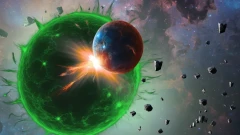
In most cases, Venus's moon did not migrate safely outward like Earth's Moon. Instead, it eventually turned around and began spiralling inward towards the planet, until it was torn apart by Venus's gravity.
An interesting detail emerged: a more massive moon would have been destroyed faster. A heavier satellite would more effectively "drain" Venus's rotation, thereby accelerating its own demise.
When a Moon Could Survive
Survival proved possible only within a narrow range of conditions. Venus would have needed to be rotating very rapidly at the time of the moon's formation—with a day shorter than about 12 hours—and the moon itself would have had to be relatively modest in mass, no more than roughly that of our Moon. Only in this case would the satellite migrate outward and stabilise. In all other scenarios, it was doomed.
"So, a surviving moon would have had to be modest in size and orbiting a rapidly rotating early Venus. And these conditions appear not to match what we imagine early Venus to have been like," Kane noted.
Can Evidence Be Found?
Direct traces of an event that occurred billions of years ago have almost certainly not survived. No telescope will show the destruction itself. However, indirect clues may remain. If a moon was destroyed and its debris fell onto Venus, it could have left a chemical fingerprint in the planet's surface or atmosphere. Future missions—particularly NASA's DAVINCI probe—will measure the atmospheric composition in detail and could help test such hypotheses.
A better understanding of Venus's internal structure would also improve the models, as the calculations depend on the planet's poorly known interior properties.
There is also a broader test. The model predicts that slowly rotating Venus-like planets around other stars should generally lack large moons. As astronomers begin systematically searching for exomoons, this prediction can be tested against real data.
What's Next
Kane and his colleagues do not plan to stop. They intend to study possible traces in Venus's composition and atmosphere that could already be tested, as well as to examine similar scenarios for Mercury and Mars. Additionally, the researchers want to apply the model to exoplanets where similar satellite collisions may have occurred.
The work is currently available as a preprint on arXiv.