make preferable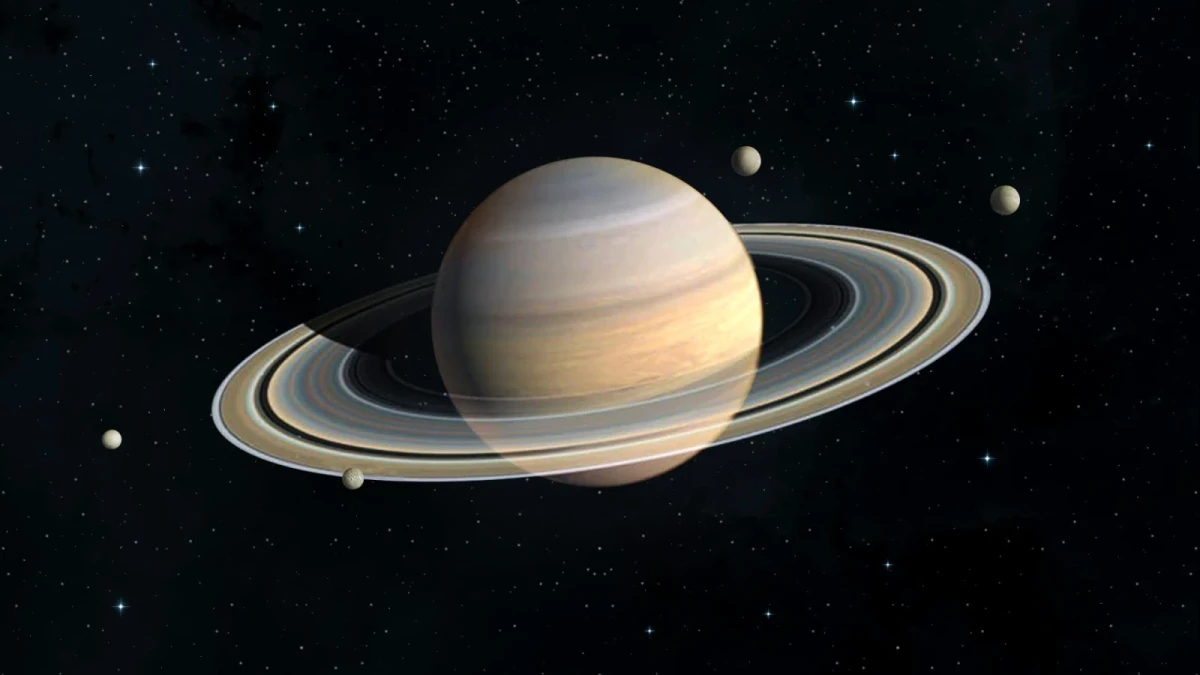
An international team of astronomers, using the Hubble Space Telescope, has discovered a huge atmospheric structure in the shape of a decagon at Saturn's south pole. The study is published in Science Advances.
What Was Observed
The team, led by Agustín Sánchez‑Lavega from the University of the Basque Country, analysed images of the planet's southern hemisphere. This region only became clearly visible from Earth in 2023 due to Saturn's axial tilt.
The detected wave is located at latitudes 58°–63° and drifts slowly eastward at about 2.5 metres per second. By comparison, the local jet stream moves much faster—up to 116 metres per second. The decagon's vertices oscillate with a period of 32 days, and the amplitude of these oscillations ranges from 4.6 to 8.4 degrees.
Modelling suggests that the appearance of such a wave may be linked to periodic wind disturbances or to the influence of a dark anticyclonic vortex located slightly to the north.
How the Southern Polygon Differs from the Northern One
Until this discovery, the only known polygon on Saturn was the famous hexagon at the north pole. It was first recorded by the Voyager spacecraft in 1980–1981 and has remained stable for more than 44 years since.
The southern decagon looks different. Images from 2023 and 2024 show that it is gradually changing, and its sides have varying contrast. This suggests that the southern wave may be a transient phenomenon, driven by instability in the local climate system.
According to the authors, the decagon offers a rare opportunity to study the dynamics of polar winds and the processes that shape stable polygonal flows on gas planets.
In Brief
Using the Hubble Space Telescope, astronomers have discovered a giant atmospheric wave in the form of a decagon at Saturn's south pole. The structure lies at latitudes 58°–63°, drifts slowly eastward, and oscillates with a period of about a month. Unlike the stable northern hexagon, known for over 40 years, the southern polygon appears variable and may be temporary. The discovery helps improve our understanding of how stable polar vortices of unusual shapes arise on gas giants.