make preferable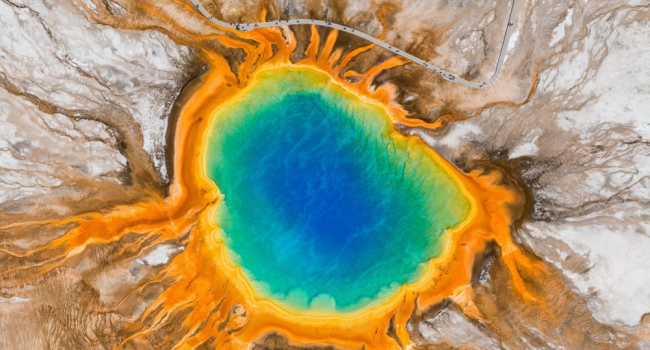
The Yellowstone volcanic system is considered one of the most famous and well-studied on the planet. It is located primarily in the state of Wyoming, USA, and covers about 3,500 square miles. Today, Yellowstone National Park is best known for its geysers, hot springs, and unusual landscapes, but beneath this tourist attraction lies a massive geological system.
Yellowstone belongs to the category of supervolcanoes — volcanic systems capable, under an extremely rare scenario, of producing an eruption of colossal power.
What is a supervolcano
Unlike a traditional cone-shaped volcano, a supervolcano is often impossible to recognize by its appearance. Such systems can take the form of vast depressions — calderas — that form after exceptionally powerful eruptions.
A supervolcano is typically defined as a volcanic system capable of producing an eruption reaching magnitude 8 on the Volcanic Explosivity Index (VEI). This involves the ejection of more than 1,000 cubic kilometers of volcanic material.
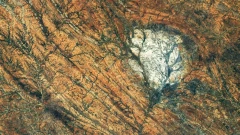
The history of Yellowstone itself demonstrates how massive such processes can be. About 640,000 years ago, one of the system's largest known eruptions occurred. Magma was ejected from the depths with such force that the surface above the magma chamber collapsed, forming the vast caldera that exists today.
The consequences could reach far beyond the US
The danger of a supervolcano lies not only in the immediate force of the explosion. Crucially, an eruption releases colossal volumes of ash and volcanic gases into the atmosphere. An illustrative example was the eruption of Iceland's Eyjafjallajökull volcano in 2010. It was incomparable in scale to a potential Yellowstone eruption, yet ash emissions into the atmosphere caused severe disruptions to European air travel for several weeks.
In the event of a supervolcanic eruption, the consequences would be far more widespread. Computer models allow for the ejection of up to roughly 1,000 cubic kilometers of ash and gases. Fine-grained ash can be carried vast distances by atmospheric currents. According to calculations performed by the UK Met Office for the BBC, ash particles under a specific scenario could reach Europe roughly three to four days after the eruption.
An even more serious issue would be sulfur-bearing gases. Upon entering the stratosphere, they can transform into aerosols that reflect sunlight back into space. As a result, global temperatures could drop sharply.
Volcanic winter
History already contains an example of how profoundly a major eruption can alter the climate. In 1815, the eruption of Mount Tambora in Indonesia led to a massive release of sulfur into the atmosphere. The period that followed became known as the "year without a summer": temperatures plunged, crops failed, and a food crisis affected Europe and North America.
A potential Yellowstone eruption would be incomparably more powerful. According to some climate models, global temperatures could drop by approximately 10 degrees Celsius, while in the Northern Hemisphere, the cooling could reach 12 degrees and last between six and ten years.
Such a scenario would mean more than just cold weather. Widespread crop failures could lead to food crises and famine, weather patterns would alter, water supply issues would arise, and ecosystems would face severe disruptions.
What would happen in Yellowstone itself
The most destructive consequences in the immediate vicinity of the volcano would be tied to red-hot pyroclastic flows — dense mixtures of hot gas, ash, and rock fragments.
Such flows can travel at speeds exceeding 300 kilometers per hour. Estimates suggest that during a super-eruption, they could spread up to 100 kilometers from Yellowstone, destroying virtually everything in their path.
Additionally, settled ash would contaminate water supplies, damage vegetation, and create severe challenges for agriculture and infrastructure.
How likely is an eruption
Despite these dramatic projections, scientists do not consider Yellowstone "overdue" for another eruption. The intervals between past major eruptions cannot be used as a calendar to pinpoint the date of the next event.
Furthermore, a significant portion of the magmatic system beneath Yellowstone is in a solid state. Research indicates that only about 5–15% of the magmatic system may be molten. Therefore, even the question of whether enough liquid magma exists for a new super-explosion remains complex.
According to the United States Geological Survey (USGS), the probability of a Yellowstone super-eruption in any given year is roughly 1 in 730,000 — about 0.00014%.
At the same time, the volcanic system remains active. Between 1,000 and 3,000 small earthquakes are recorded annually in the Yellowstone area. Most are imperceptible to humans, but for scientists, they serve as a crucial monitoring tool for processes occurring deep underground.
Researchers are constantly refining maps of the subsurface magmatic system to better understand the distribution of magma and fluid movements at depth.
A catastrophic scenario that remains extremely unlikely
A super-eruption at Yellowstone would rank among the most devastating natural disasters in human history. However, the probability of such an event in the foreseeable future remains extremely low. The USGS emphasizes that there are no signs of an impending catastrophic eruption, and the system does not operate on a regular schedule, meaning past eruption intervals cannot serve as a reliable method for predicting the next one.
That is why Yellowstone today serves primarily as an object of continuous scientific observation: scientists monitor earthquakes, ground deformation, and the state of the magmatic system to detect any potential changes in time.
The article was prepared based on materials from the BBC.