make preferable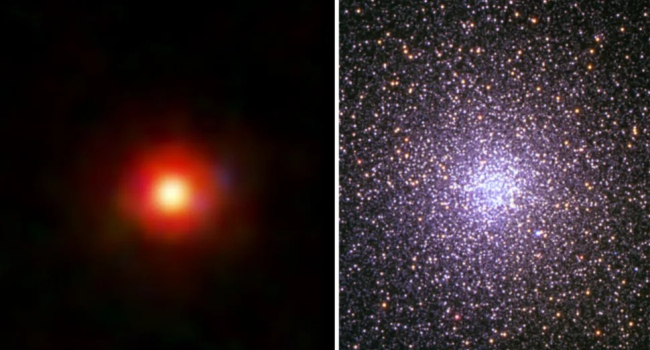
Scientists have proposed a new interpretation of the mysterious "Little Red Dots" that the James Webb Space Telescope detected in the early Universe. According to the study, these objects may be forming globular star clusters with supermassive stars at their centers, reports Space.com.
What are the "Little Red Dots"
Since 2022, JWST has regularly detected these bright, compact objects in the early Universe (roughly 600 million years after the Big Bang). By 2 billion years, they practically disappear. Astronomers have put forward various hypotheses: from galaxies with active black holes to "black holes wrapped in gas."
A new hypothesis
A team led by John Chisholm from the University of Texas at Austin suggests that the Little Red Dots are forming globular clusters containing supermassive stars with masses ranging from 1,000 to 10,000 solar masses.
Supermassive stars, which arise in the dense environment of early clusters due to frequent collisions and mergers, could explain:
- The characteristic red emission
- The high helium content and certain metals in modern globular clusters
- The time window of appearance and disappearance of the objects
After a short life (only about a million years), these stars explode as supernovae, enriching the surrounding environment with elements that will later become part of the next generations of stars.
Why this matters
If the hypothesis is correct, the Little Red Dots will help to better understand how globular clusters — among the oldest structures in galaxies — formed. This also links the early Universe with modern observations.
Study co-author Mike Boylan-Kolchin noted that there is no single "smoking gun" that unequivocally proves the Little Red Dots are globular clusters, but this explanation would account for many diverse and unexpected observations at once.
The study is available as a preprint on arXiv.
In brief
Scientists have suggested that the mysterious "Little Red Dots" detected by the James Webb telescope in the early Universe may be forming globular star clusters with supermassive stars at their centers. This would explain their appearance about 600 million years after the Big Bang and their subsequent disappearance. The hypothesis links the early Universe to modern globular clusters in galaxies. The work was published as a preprint on arXiv.