make preferable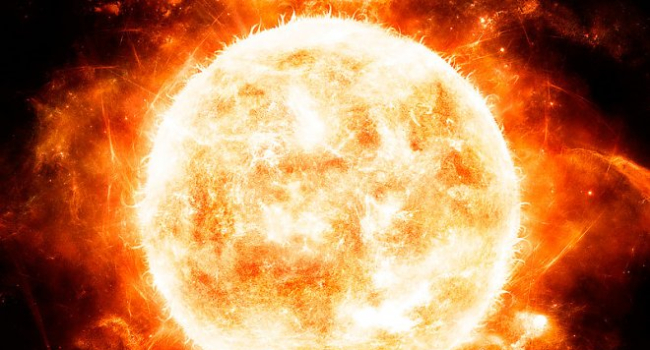
On May 18, the automatic probe Solar Orbiter detected a large group of sunspots on the far side of the Sun, which is not visible from Earth. The scale of the active region sparked discussion in the scientific community, as similar activity exactly one year ago led to one of the strongest geomagnetic storms in recent decades.
As reported by Gazeta.Ru, Candidate of Physical and Mathematical Sciences and expert at the Perm National Research Polytechnic University Evgeny Burmistrov explained that the current situation is noticeably different from the events of May 2024.
The key difference is location
Burmistrov explained that the peak of solar activity is currently occurring on the far side of the Sun, meaning the main flow of energy is directed away from Earth. However, he noted that due to the Sun’s rotation, part of this activity could face our planet in a few weeks and potentially trigger geomagnetic storms.
He added that in 2024, Earth was directly hit by the most intense burst of solar energy, whereas the expected effects this time appear to be more moderate. He also emphasized that scientists currently have an important advantage — time.
Two weeks for preparation
The Solar Orbiter operates in a special orbit that allows it to observe the far side of the Sun, which is inaccessible to ground-based telescopes. This gives scientists about two weeks to analyze the evolution of the active region and make more accurate forecasts.
At the same time, Burmistrov noted that sunspots are highly short-lived structures. During this period, they may either intensify and produce powerful flares or significantly weaken or disappear entirely. At present, it is not possible to predict their exact development.
Is it dangerous for people?
The expert emphasized that even in the worst-case scenario, there is no direct threat to human health.
He stated that such phenomena are primarily of scientific interest and that in some cases they may only cause short-term disruptions in radio communications and navigation systems.
In brief
The Solar Orbiter has detected a large group of sunspots on the far side of the Sun. Unlike May 2024, when strong solar activity directly affected Earth, the current energy flow is directed away from our planet. In a few weeks, the active region may rotate toward Earth, potentially causing moderate geomagnetic storms. Scientists now have time to monitor and refine forecasts. There is no danger to human health, though brief disruptions in radio communications and navigation systems are possible.