make preferable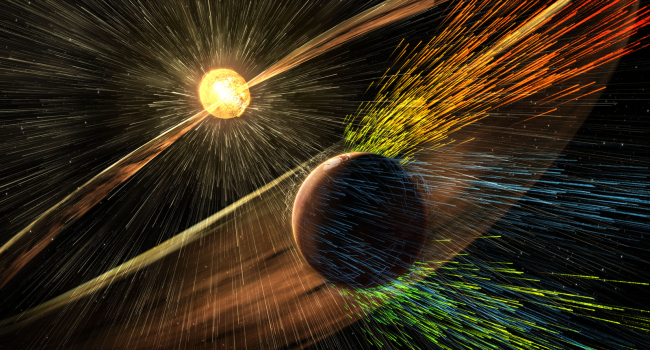
The European solar probe Proba-3, which simulates solar eclipses, has made an unexpected discovery: in the lower layers of the solar corona, the so-called “slow” solar wind moves significantly faster than previously assumed—by a factor of three to four.
What Was Discovered
Previously, it was believed that the “slow” solar wind, formed near the surface of the Sun, moved at a speed of about 100 km/s. However, data from Proba-3 showed that in the near-surface region of the corona, bursts of this wind accelerate to 480 km/s, a speed typical of the “fast” solar wind from coronal holes.
The lead author of the study, Andrei Zhukov of the Royal Observatory of Belgium, reported that in the inner corona—an area that is extremely difficult to observe—bursts of slow solar wind were detected moving three to four times faster than expected.
How the “Invisible” Was Observed
Observing the inner corona is extremely difficult because it is a million times dimmer than the bright solar disk. Ground-based telescopes using artificial occulting disks are forced to block precisely the region where the solar wind forms. Natural total solar eclipses provide only a few minutes of observation time each year.
The Proba-3 probe addressed this problem in a radical way. Two satellites fly in formation at a distance of 150 meters from each other. One acts as a giant occulting disk, blocking the Sun’s disk for the second observing satellite. Since December 2024, the mission has already created 57 artificial eclipses and accumulated 250 hours of high-quality video of the inner corona.
Why This Matters
Solar wind is a stream of charged particles that constantly flows from the Sun and fills the entire Solar System. It causes geomagnetic storms, auroras, and affects the operation of satellites and ground-based technologies.
The “slow” solar wind is thought to form when magnetic field lines on the Sun break and reconnect. It is released unevenly, in separate “clumps,” which appear in images of the corona as bright rays.
New data from Proba-3 show that the acceleration of this wind begins much closer to the surface of the Sun than previously believed. This changes the understanding of the mechanisms responsible for heating and accelerating solar plasma.
The mission’s scientific director, Joe Zander, noted that researchers were now able to track how the solar wind accelerates near the Sun, that this was visible across the entire field of view of Proba-3, and that speeds and accelerations had already been recorded that surprised the team.
What Comes Next
The collected dataset is only the beginning of a long process. Scientists plan to continue observations and analyze exactly how the solar wind accelerates at different altitudes and within different magnetic structures.
The study was published in March in The Astrophysical Journal Letters.
In Brief
The European Proba-3 mission, which creates artificial solar eclipses, discovered that the “slow” solar wind in the lower layers of the solar corona moves three to four times faster than previously thought—reaching up to 480 km/s instead of the expected 100 km/s. This discovery became possible thanks to the unique configuration of two satellites, one of which blocks the Sun’s disk for the other. The new data change the understanding of the processes responsible for heating and accelerating solar plasma and will help improve space weather forecasting. The study was published in The Astrophysical Journal Letters.