make preferable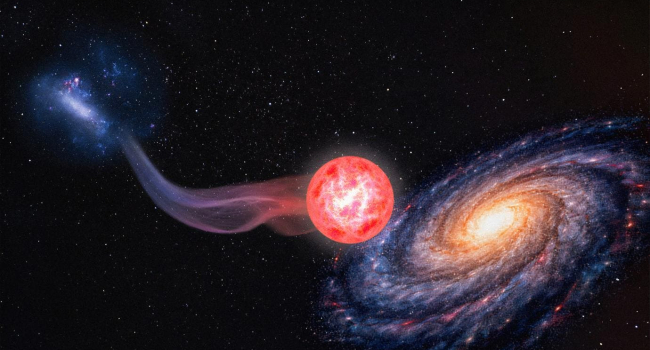
An international team of astronomers has discovered the most chemically pristine star ever observed. The star SDSS J0715-7334 contains an extremely small amount of heavy elements—just 0.005% of their abundance in the Sun. According to the scientists, it may have formed from a gas cloud polluted by the remnants of the explosion of one of the very first stars in the Universe—the so-called Population III stars.
Closest to Primordial Matter
The first stars in the Universe, which appeared several hundred million years after the Big Bang, consisted almost entirely of hydrogen and helium. They were enormous, lived short lives, and ended as powerful supernovae, enriching the surrounding space with the first heavy elements.
Direct observation of such stars is still impossible—they either exploded long ago or, if they were low-mass, are extremely rare. Therefore, scientists search for their “daughter” stars—objects formed from gas polluted by the remnants of Population III explosions.
The star SDSS J0715-7334, discovered in data from the Sloan Digital Sky Survey, has set a new record for chemical purity. Its composition consists almost entirely of hydrogen and helium. The previous record-holder (SDSS J1029+1729) contained twice as many heavy elements.
Alexander Ji of the University of Chicago noted that the star contained so little carbon that this indicated extremely early and minimal contamination by cosmic dust.
Kevin Schlaufman of Johns Hopkins University added that although the star itself did not have a completely primordial composition, it was closer than any previously discovered object to the Population III generation in this respect.
Where It Came From
The star is located about 80,000 light-years away from us and appears to be migrating from the outer halo of the Large Magellanic Cloud (LMC). For this reason, students working with the data gave it the nickname “Ancient Immigrant.”
The Large and Small Magellanic Clouds are relatively recent “arrivals” in the vicinity of the Milky Way. For a long time, few new stars formed there, which means that more chemically pristine objects can still be found there than in our own Galaxy.
Schlaufman suggested that in galaxies like the Magellanic Clouds, scientists might find relatively more extremely metal-poor stars than in the Milky Way.
How the “Daughter” of the First Star Was Born
Analysis of the chemical composition of SDSS J0715-7334 made it possible to reconstruct the characteristics of its progenitor star. The scientists concluded that it had a mass of at least 30 solar masses and ended its life as a supernova with an unusually high explosion energy. Its remnants polluted the primordial gas cloud from which the observed star later formed.
Significance of the Discovery
The discovery helps scientists better understand the processes that took place in the early Universe, when the first stars and the first heavy elements were forming. It also confirms that even billions of years later, “fragments” of that ancient era can still be found in our Galaxy and its satellites.
The study was published on April 3 in the journal Nature Astronomy.
In Brief
Astronomers have discovered the most chemically pristine star known—SDSS J0715-7334. It contains only 0.005% of the heavy elements found in the Sun and most likely formed from gas polluted by the remnants of the explosion of one of the first stars in the Universe (Population III). The star, nicknamed “Ancient Immigrant,” is migrating from the halo of the Large Magellanic Cloud. This discovery brings scientists closer to understanding the chemical evolution of the early Universe and shows that even today it is possible to find “descendants” of the very first stars. The work was published in the journal Nature Astronomy.