make preferable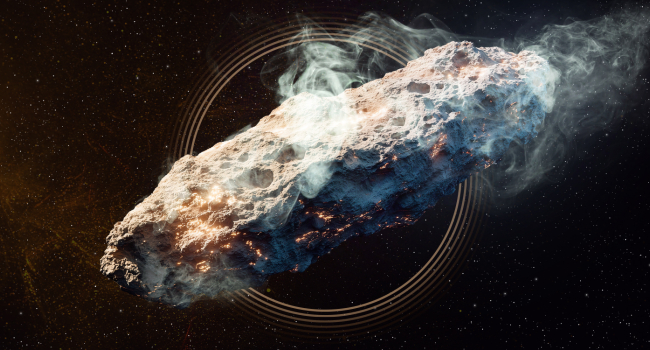
The European spacecraft Jupiter Icy Moons Explorer (JUICE), currently traveling toward Jupiter, has unexpectedly detected unusually high activity from the third confirmed interstellar object in the Solar System, 3I/ATLAS. The comet is releasing about two tons of water vapor per second into space—equivalent to roughly 70 Olympic swimming pools of water every day.
An Unexpected Discovery by JUICE
The JUICE spacecraft, operated by the European Space Agency, observed comet 3I/ATLAS in November 2025 using two scientific instruments: the MAJIS spectrometer and the JANUS camera. These observations were not originally planned—the object was discovered only on July 1, 2025, and the mission team decided to take advantage of the spacecraft’s favorable position.
The MAJIS instrument detected strong infrared signals from water vapor and carbon dioxide. These volatile substances were actively escaping from the comet’s nucleus after it passed Perihelion.
Giuseppe Piccioni of the National Institute for Astrophysics (Italy) reported that repeated detections of water vapor and carbon dioxide by MAJIS indicated that volatile ices hidden beneath the surface were being actively released into space shortly after perihelion. Based on the collected data, the team estimated that material was flowing from the comet’s nucleus at about two tons per second, equivalent to roughly 70 Olympic swimming pools of water vapor being expelled into space each day.
What the Comet’s Activity Reveals
Comet 3I/ATLAS is the third confirmed interstellar object to visit the Solar System, following 1I/ʻOumuamua and 2I/Borisov. Unlike comets native to the Solar System, it formed around another star billions of years ago. Its increased activity after perihelion allows scientists to study the composition of material that formed planets in a distant star system.
The JANUS camera also captured images of a bright coma, a tail, and complex morphological structures such as jets, rays, and filaments.
Pasquale Palumbo, principal investigator for the JANUS instrument, stated that the team was very pleased with the camera’s performance, noting that the observations demonstrate what the instrument will be capable of during its studies of Jupiter and its icy moons.
Why This Matters
Observations by Jupiter Icy Moons Explorer (JUICE) provide a rare opportunity to study the “building material” of another planetary system. The high rate of water and other volatile emissions suggests that the comet’s nucleus still contains large amounts of primordial ice that has remained relatively unchanged during billions of years of travel through space.
Data received in February 2026—delayed due to the long transmission time from the spacecraft—still require detailed analysis. However, it is already clear that 3I/ATLAS is significantly more active than scientists had expected.
In Brief
The interstellar comet 3I/ATLAS is releasing about two tons of water vapor per second into space—equivalent to roughly 70 Olympic swimming pools of water every day. The unexpected discovery was made by instruments aboard the Jupiter Icy Moons Explorer (JUICE) in November 2025. The comet’s high activity after perihelion allows scientists to study the composition of material that formed planets around another star billions of years ago. Observations also revealed complex structures within the coma and tail. This is the third confirmed interstellar object detected in the Solar System, and it has proven to be one of the most active observed so far.