make preferable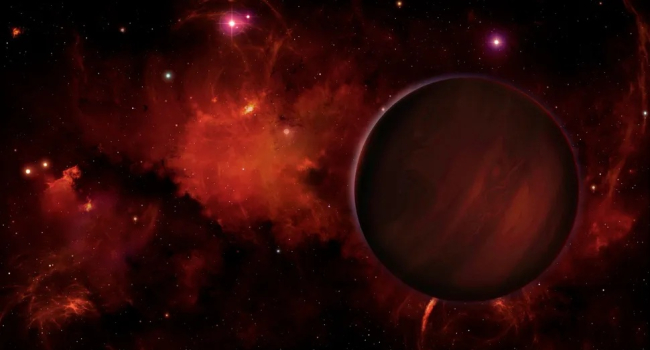
Rogue planets, not bound to any star, have long been considered dead and hopeless worlds. However, a new study suggests that their moons may be able to maintain liquid water on their surfaces for up to 4.3 billion years—almost as long as Earth has existed. This is made possible by tidal heating and a dense hydrogen atmosphere that acts like a powerful thermal blanket. The study has been published as a preprint on arXiv.
How to survive without a sun
According to Space.com, free-floating (rogue) planets are cosmic “outcasts” that were ejected from their star systems during the early chaotic stages of formation. There may be tens of times more of them than ordinary planets. It has generally been assumed that without a star, such worlds are locked in permanent cold and are uninhabitable.
However, rogue planets often retain moons. After ejection, their orbits become highly elongated. When a moon moves closer to its planet, gravitational forces strongly compress and stretch its interior. This creates friction and releases heat—a process known as tidal heating. It is the same mechanism that keeps subsurface oceans liquid on Europa and Enceladus in our Solar System.
Hydrogen instead of carbon dioxide
Previously, scientists attempted to use carbon dioxide as the primary greenhouse gas. But under extremely low temperatures and high pressure, CO₂ condenses and “falls out” of the atmosphere, leading to atmospheric collapse.
The new model shows that hydrogen works much more effectively. In a dense atmosphere, hydrogen molecules begin to absorb infrared radiation during collisions (an effect known as collision-induced absorption). This allows the heat generated by tidal forces to be retained instead of escaping into space.
The simulation results are striking: an Earth-sized moon orbiting a Jupiter-like rogue planet could maintain surface conditions suitable for liquid water for up to 4.3 billion years.
What this means for the search for life
If this hypothesis is correct, the number of potentially habitable worlds in the universe increases significantly. Life may exist not only in traditional “habitable zones” around stars, but also in complete darkness in interstellar space—on moons of rogue planets.
This opens up an entirely new category of objects in the search for biosignatures. Future missions, such as Dragonfly to Titan, will help scientists better understand how similar processes work on cold worlds with hydrocarbon chemistry.
In brief
Moons of rogue planets may be able to sustain liquid water on their surfaces for up to 4.3 billion years thanks to tidal heating and a dense hydrogen atmosphere that effectively traps heat. This is far longer than previously thought. The study significantly expands the list of potentially habitable worlds in the universe—life may exist even in the complete darkness of interstellar space. The work has been published as a preprint on arXiv.