make preferable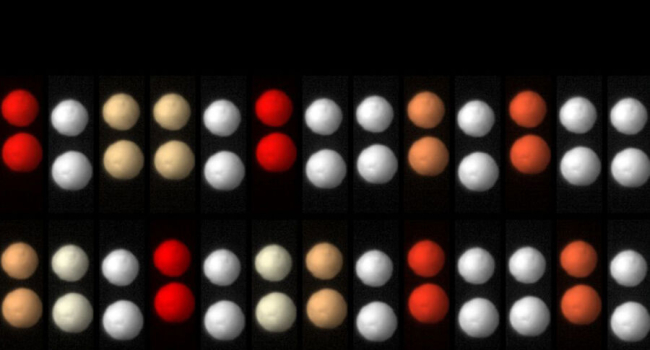
Time crystals — one of the most exotic phenomena in modern physics — were long thought to be purely quantum effects requiring ultralow temperatures, lasers, vacuum chambers, and entangled particles. However, a team from New York University has demonstrated that a similar breaking of time symmetry can be observed in an ordinary classical system using surprisingly simple tools. The experiment required only two tiny polystyrene beads and acoustic levitators. The study was published in Physical Review Letters.
What Is a Time Crystal?
A time crystal is not a substance in the traditional sense but a special type of system behavior. In a conventional crystal, atoms form a periodic structure in space. In a time crystal, particles (or spins or other degrees of freedom) spontaneously begin oscillating with a fixed period in time — without any external periodic driving, like a metronome.
This behavior breaks one of nature’s fundamental symmetries: time symmetry. Until recently, all known time crystals had been created in quantum systems, such as trapped ions, superconducting qubits, and magnetic spins in diamonds.
How They Built One from Styrofoam
The physicists, led by David Grier, study particle interactions in acoustic traps. They suspend tiny polystyrene beads (about 1 mm in diameter) in midair using standing sound waves.
“Sound waves can act on particles much like waves on the surface of water act on a leaf,” explained study co-author Mia Morrell.
Levitation is achieved through a precisely tuned acoustic field that holds the beads at pressure nodes. The key detail, however, is a slight asymmetry: the two beads differ slightly in size and shape, causing each to scatter sound in a slightly different way.
As a result, the force one bead exerts on the other through the acoustic field is not equal to the reverse force. Under certain conditions — including distance, sound intensity, and mass — the system transitions into a regime of spontaneous, stable oscillations. The beads begin moving rhythmically back and forth with a clear period, and these oscillations can continue for hours without any external “push.”
The Simplest Time Crystal Yet
“Time crystals seem exotic and extraordinarily complex, but our system is remarkable for its simplicity,” Grier noted.
In essence, this may be the most minimal time crystal ever created: just two particles. There is no need for cryogenics, superconductivity, laser cooling, or quantum entanglement. Everything occurs at room temperature, in air, using ordinary speakers and inexpensive foam.
The authors emphasize that the discovery has no immediate practical applications — at least not yet — but it provides a convenient macroscopic model for studying such phenomena. Similar asymmetric interactions appear in biology (for example, heart rhythms and cellular oscillations), although biological clocks are not time crystals in the strict sense.
What Comes Next
The work opens the door to a new class of classical systems that break time symmetry. Physicists can now investigate transitions into these states, their stability, and possible analogies with quantum time crystals — all on a laboratory tabletop without multimillion-dollar equipment.
In Brief
Physicists at New York University have created a classical time crystal using two polystyrene beads levitating in a sound field. Due to slight asymmetry, the particles spontaneously enter stable periodic motion without external periodic driving — a phenomenon previously considered purely quantum. It is the simplest and least expensive example of a time crystal to date: a room, speakers, and Styrofoam. The discovery is published in Physical Review Letters.