make preferable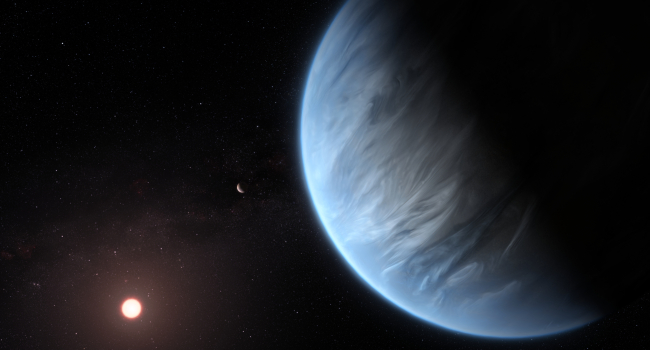
The exoplanet K2-18 b, located 124 light-years from Earth, has already attracted attention: the James Webb telescope detected potential biosignatures in its atmosphere — dimethyl sulfide (DMS), a molecule that on Earth is produced only by living organisms. Now a new study makes the planet even more promising: the star K2-18 has turned out to be exceptionally quiet, lacking the powerful flares that can destroy planetary atmospheres. The preprint of the study has been published on arXiv.
A Red Dwarf That Doesn’t Explode
K2-18 is a typical red dwarf: cool, faint, and generally active. Stars of this type often emit X-ray and radio flares capable of stripping away the atmospheres of nearby planets. K2-18 b orbits within the habitable zone — the region where liquid water could exist — but without sufficient protection it could have been reduced to a bare rock.
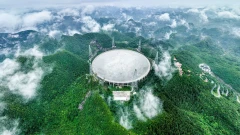
A team of astronomers led by an international group of researchers carried out a 12-week monitoring campaign using the Karl G. Jansky Very Large Array (VLA), observing the star at frequencies between 2 and 10 GHz. The result showed no signs of activity in the radio spectrum: no bursts and no coronal mass ejections.
The authors noted that the absence of radio signals from K2-18 indicates an unusual level of quietness, which they regarded as a major advantage for the preservation of K2-18 b’s atmosphere.
How Much of the Atmosphere Survived?
According to their calculations, with such low stellar activity the planet has lost only about 3% of its atmosphere over its entire history. For comparison, planets orbiting active red dwarfs can lose tens of percent — as is estimated for Proxima Centauri b.
This implies that:
- The atmosphere of K2-18 b is dense and stable
- Conditions for liquid water can persist for billions of years
- Potential biosignatures such as DMS are not destroyed by radiation
Limitations and Prospects
The observations consisted of short 10-minute sessions, meaning that rare flares could have been missed. However, the results are consistent with X-ray and optical observations, which likewise indicate that the star is indeed quiet.
Future plans include:
- Long-duration monitoring (over months)
- Observations with JWST and ARIEL in the 2030s
- Searches for additional gases such as O₂ and CH₄
K2-18 b is considered a priority target for the Artemis program, the Habitable Worlds Observatory, and PLATO.
In Brief
K2-18 is an exceptionally quiet red dwarf with no flares capable of destroying the atmosphere of its planet. K2-18 b has lost only about 3% of its atmosphere over billions of years. This preserves conditions suitable for life and supports the detection of biosignatures such as DMS. The star’s silence is a key factor for habitability, making K2-18 b one of the strongest candidates for extraterrestrial life.