make preferable
Astronomers have made a breakthrough discovery of complex organic molecules frozen in ice around a young star outside the Milky Way, marking the first detection of such life-forming compounds beyond our galaxy. The finding suggests that the chemical ingredients for life may be far more widespread in the universe than previously thought, according to EurekAlert.
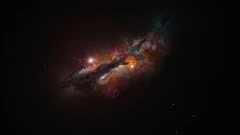
Using the mid-infrared instrument of the James Webb Space Telescope, an international team led by University of Maryland and NASA researcher Marta Sevilo identified five distinct carbon-based compounds in the ice surrounding a protostar named ST6 in the Large Magellanic Cloud, located approximately 160,000 light-years from Earth.
First Detection Beyond the Milky Way
The team discovered methanol and ethanol—common alcohols found on Earth—as well as industrial compounds methyl formate and acetaldehyde. Most significantly, they made the first definitive detection of acetic acid, a primary component of vinegar, in cosmic ice. Researchers also observed spectral features suggesting the possible presence of glycolaldehyde, a molecule related to sugars and a precursor to RNA components, though further analysis is needed for confirmation.
“Before Webb, methanol was the only complex organic molecule definitively detected in ice around protostars, even within our own galaxy,” Sevilo explained, as reported by Astrophysical Journal Letters. “The exceptional quality of our new observations allowed us to gather an immense amount of information from a single spectrum, more than ever before.”
The results, published in Astrophysical Journal Letters on October 20, 2025, represent a monumental breakthrough in detecting complex organic molecules in extraterrestrial environments, leveraging Webb’s unprecedented sensitivity and spectral resolution.
Implications for Early Universe Chemistry
This discovery is particularly remarkable due to the harsh environment in which these molecules were found. The Large Magellanic Cloud contains only one-third to half the heavy elements found in our solar system and is exposed to much stronger ultraviolet radiation—conditions resembling those of early universe galaxies.
“The low-metallicity environment is intriguing because it mirrors galaxies from earlier cosmological epochs,” Sevilo noted. “What we study in the Large Magellanic Cloud can be applied to understanding those more distant galaxies from when the universe was much younger.”
Dr. Yakko van Loon from Keele University, who contributed to the study, emphasized its significance for astrobiology: “Acetic acid, methyl formate, and possibly glycolaldehyde are all linked to the creation of the first sugars that form the basis of RNA and DNA—the foundation of life. Finding them in the more pristine environment of the Large Magellanic Cloud suggests that life could have emerged elsewhere far earlier than on Earth.”
Study co-author Will Rocha from Leiden University explained that these complex organic molecules form through chemical reactions in both gas phases and on the icy surfaces of interstellar dust grains. The discovery confirms theoretical models showing that surface chemistry on dust grains drives the synthesis of complex molecules, even in challenging conditions with fewer heavy elements available for chemical reactions.