make preferable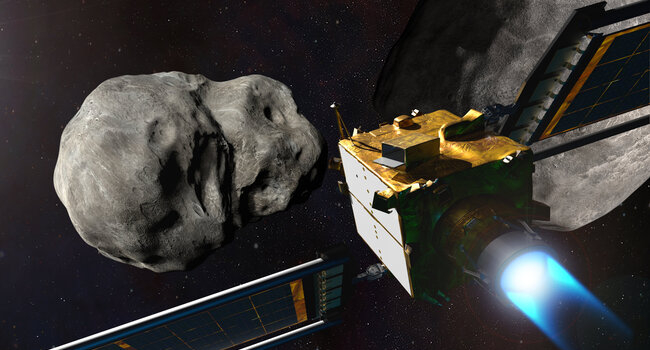
Scientists presented new methods at the joint EPSC-DPS2025 meeting in Helsinki this week for precisely conducting asteroid deflection missions to prevent future collisions with Earth, with special attention to a previously overlooked danger: poorly directed deflections could inadvertently guide asteroids through gravitational "keyholes," potentially placing them back on a collision course with our planet.
In a study presented by Rahil Makadia, a NASA Space Technology Graduate Research Opportunity fellow from the University of Illinois Urbana-Champaign, it was noted that indiscriminate targeting during deflections might only delay, rather than eliminate, the asteroid threat. Makadia’s team developed probability mapping techniques to identify the safest impact points on asteroid surfaces.
Gravitational Keyholes Create New Risks
The concept of gravitational "keyholes" represents a previously underestimated hazard for planetary defense missions. These small regions of space near Earth can alter the trajectory of a passing asteroid due to gravitational forces, effectively steering it onto a collision course with our planet during future encounters.
According to Makadia’s research, each point on an asteroid’s surface carries a different level of risk of the object passing through these hazardous zones after deflection. "If an asteroid passes through one of these keyholes, its motion through the Solar System will lead it to a collision course with Earth in the future," Makadia explained at the Helsinki conference.
The findings emphasize that asteroid deflection missions must consider not only the immediate need to divert collision trajectories but also the risk of passing through these gravitational traps, which could pose a delayed threat.
Probability Mapping Guides Safe Target Selection
Makadia’s team developed computational methods to create probability maps assessing risk levels across an asteroid’s surface. These maps account for the object’s shape, surface topography (including hills and craters), rotation speed, and mass distribution.
The methodology can be applied at a preliminary level using only ground-based observations, though specialized reconnaissance missions would provide optimal data for precise targeting calculations. This flexibility is crucial, given that the limited time between an asteroid’s discovery and a potential Earth impact often does not allow for detailed space missions.
By modeling potential trajectories under various impact scenarios, scientists can identify locations that minimize the likelihood of asteroids being deflected through gravitational "keyholes" while maximizing deflection efficiency.