make preferable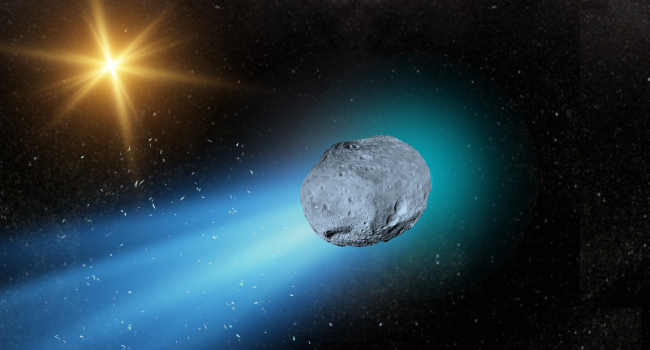
In early October 2025, Mars will become the best vantage point in the Solar System for observing a unique interstellar object — comet 3I/ATLAS. The European Space Agency (ESA) is preparing its Martian orbiters to study this rare visitor, which will pass at a record close distance to the Red Planet, Space.com reports.
Discovery of the Interstellar Comet
Comet 3I/ATLAS (officially C/2025 N1) was discovered on July 1, 2025, by an international team of astronomers using the ATLAS telescope system. It is the third interstellar object detected in our Solar System, after 1I/ʻOumuamua (2017) and 2I/Borisov (2019). The designation “3I” indicates its interstellar origin, while the name ATLAS reflects the instrument used for its discovery.
On October 3, 2025, the comet will pass just 30 million kilometers from Mars, far closer than its minimum distance to Earth — 270 million kilometers. This makes Martian orbiters the perfect tools for observation.
ESA’s Plans: Observations from Mars
ESA plans to use its two spacecraft currently orbiting Mars — Mars Express and the ExoMars Trace Gas Orbiter (TGO) — to study the comet. Colin Frank Wilson, ESA’s lead scientist for Mars orbiter missions, confirmed: “We plan to observe 3I/ATLAS during its closest approach to Mars on October 3.”
Instruments for Observation
- Mars Express:
- The High Resolution Stereo Camera (HRSC) will attempt to capture images of the comet. If 3I/ATLAS proves bright enough, HRSC could determine its shape — elongated, spherical, or irregular. By comparison, 1I/ʻOumuamua resembled an asteroid, while 2I/Borisov behaved like a typical comet.
- The OMEGA and SPICAM spectrometers will try to analyze the composition of the coma (the gas cloud surrounding the comet’s nucleus), detecting molecules such as water vapor or organic compounds.
- ExoMars TGO:
- The Colour and Stereo Surface Imaging System (CaSSIS) will help study the comet’s activity, including gas and dust emissions, as well as its chemical composition.
- The NOMAD spectrometer will be used to analyze the comet’s spectrum, although scientists note that the object’s brightness may not be sufficient for detailed results.
Wilson added that given the large distance (30 million km), obtaining detailed images will be challenging, but even basic data will help scientists better understand the nature of this interstellar visitor.
Other Spacecraft and Opportunities
Alongside ESA’s orbiters, other spacecraft may also contribute to observations:
- NASA: American orbiters MAVEN and Mars Reconnaissance Orbiter (MRO) could be used. MRO carries a powerful camera capable of high-quality imaging.
- China: The Tianwen-1 orbiter, equipped with a high-resolution camera, could also participate.
- JUICE: ESA’s spacecraft en route to Jupiter’s moons plans to observe the comet in November 2025 using four instruments, despite thermal limitations.
- Distant missions: Probes such as Europa Clipper, Hera, and Lucy may cross the comet’s tail after perihelion (closest approach to the Sun), allowing them to gather data on its composition.
ESA also considered using the Hera probe, which studies the Didymos–Dimorphos asteroid system after NASA’s DART mission, but the comet proved too faint from its vantage point.
A View from Earth
Closer to home, the James Webb Space Telescope (JWST) has already observed the comet, capturing its first images and revealing unexpected results. Although details remain undisclosed, JWST’s data may complement Martian observations by providing further insights into the comet’s composition and activity.
Why It Matters
Interstellar objects like 3I/ATLAS present a rare chance to study matter from other star systems. They may hold clues about the chemical makeup and formation conditions of distant stars. Unlike 1I/ʻOumuamua, which resembled an asteroid, and 2I/Borisov, which behaved like a typical comet, 3I/ATLAS could provide new information on the diversity of interstellar bodies.
Observations from Mars will allow scientists to:
- Determine the comet’s shape and structure.
- Study its chemical composition and activity (gas and dust emissions).
- Compare 3I/ATLAS with other interstellar objects and Solar System comets.
What’s Next?
The flyby of comet 3I/ATLAS on October 3, 2025, will be an important milestone for astronomy. ESA and its partners, including NASA and China, are preparing to take full advantage of this opportunity. After passing Mars, the comet will continue its journey through the Solar System, and scientists hope to collect additional data from spacecraft such as JUICE and Europa Clipper. These observations will help deepen our understanding of interstellar objects and their role in the cosmos.
In Brief
Comet 3I/ATLAS is the third interstellar object discovered in our Solar System, and its October 2025 flyby of Mars offers a unique scientific opportunity. ESA will use its Mars Express and ExoMars TGO orbiters to study its shape, composition, and activity, while other spacecraft, including JWST and Tianwen-1, will complement the data. This event underscores the importance of international cooperation in space research and may reveal new secrets about interstellar travelers.