make preferable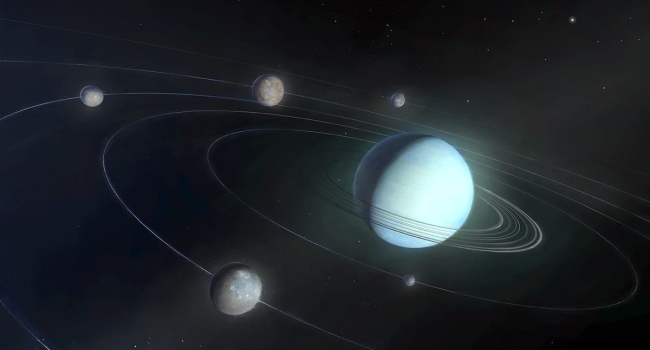
Astronomers from the Southwest Research Institute (SwRI) in the United States, using NASA’s James Webb Space Telescope (JWST), have discovered a previously unknown moon of Uranus, raising the planet’s total number of known satellites to 29. The newly identified object, temporarily designated S/2025 U1, is the smallest moon of Uranus detected so far. The findings were published on NASA’s website on August 19, 2025.
How Was the Moon Discovered?
The discovery took place on February 2, 2025, during observations made with JWST’s Near-Infrared Camera (NIRCam). Detecting the moon required a series of ten long-exposure images, each lasting 40 minutes, which captured faint reflected light from the object.
“This is a small but important discovery—even Voyager 2, which flew past Uranus nearly 40 years ago, couldn’t detect it,” said lead researcher Mariam El Mutamid of SwRI.
S/2025 U1 measures only about 10 kilometers across, making it too dim to have been spotted by previous missions, including Voyager 2’s 1986 flyby. Thanks to JWST’s exceptional infrared sensitivity, scientists were able to identify the tiny object despite its faint glow and proximity to Uranus’s rings.
Characteristics and Orbit
The new moon orbits about 56,000 kilometers from Uranus’s center, between the orbits of Ophelia (diameter ~43 km) and Bianca (~64×46 km). Its orbit is nearly circular and lies in Uranus’s equatorial plane, suggesting that it likely formed near its current position rather than being captured from elsewhere.
“Uranus already holds the record for the number of small inner moons, and their interactions with the rings point to a complex and chaotic history. This new moon is even smaller and fainter than the others—meaning the system may be even more intricate than we thought,” noted Matthew Tiscareno of the SETI Institute.
S/2025 U1 becomes the 14th member of Uranus’s group of small inner moons, which orbit closer to the planet than its larger satellites—Miranda, Ariel, Umbriel, Titania, and Oberon. These inner moons actively interact with Uranus’s rings, shaping their structure and stability.
Why the Discovery Matters
The detection of S/2025 U1 highlights JWST’s unique ability to study the outer Solar System. Its NIRCam can capture objects previously overlooked due to their small size or faint light.
“This telescope is opening up new horizons in the outer Solar System. Voyager 2 gave us our first close-up look at Uranus in 1986, and now, decades later, James Webb is continuing that mission,” El Mutamid added.
The discovery reinforces the idea that Uranus’s system is highly dynamic and complex, with moons and rings locked in constant interaction. Scientists believe even smaller moons may remain hidden near the planet’s rings, awaiting detection.
What’s Next?
The International Astronomical Union (IAU) will soon assign an official name to S/2025 U1. By tradition, Uranus’s moons are named after characters from the works of William Shakespeare or Alexander Pope, so the new moon will likely follow this convention.
Future studies with JWST aim to:
- Refine the orbit and characteristics of S/2025 U1.
- Search for additional small moons near Uranus’s rings.
- Investigate the interactions between the inner moons and the rings to better understand their evolution.
In Brief
The discovery of Uranus’s 29th moon, S/2025 U1, marks another milestone for the James Webb Space Telescope in uncovering the Solar System’s secrets. This tiny object, only 10 km in diameter and located between the orbits of Ophelia and Bianca, illustrates the complexity and chaotic nature of Uranus’s satellite system. Thanks to JWST’s powerful infrared vision, scientists were able to detect what Voyager 2 missed nearly 40 years ago. Next up: choosing a name for the new moon—and continuing to reveal the mysteries of the ice giant and its surroundings.