make preferable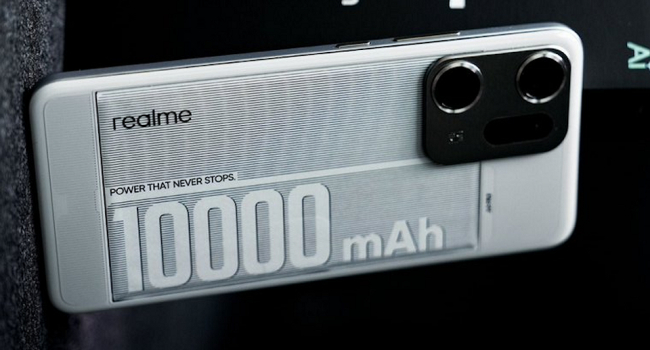
In the first half of 2026, the world may see the first mass-produced smartphone with a 10,000 mAh battery that remains surprisingly thin. According to well-known insider Digital Chat Station, the device is currently in testing, with a thickness of just 8.5 mm — comparable to modern flagships like the iPhone 16 Pro Max. Most likely, this breakthrough will be made by Realme, which previously introduced a smartphone concept under the GT line with a similar battery. This new device promises to mark the beginning of a new era of high-autonomy devices, thanks to advanced silicon-carbon battery technology.
A Battery Revolution
The key to creating such a powerful and compact battery lies in the use of a silicon-carbon anode. This technology, which began development back in 2007 at Stanford University, significantly outperforms traditional lithium-ion batteries that use graphite anodes. Silicon can hold up to ten times more lithium ions, offering a theoretical specific capacity of up to 4,200 mAh/g compared to 372 mAh/g for graphite. This makes it possible to produce higher-capacity batteries without increasing their physical size.
The Realme prototype uses a battery with an energy density of 887 Wh/L, allowing a 10,000 mAh battery to fit inside a body just 8.5 mm thick. By comparison, current flagships like the Xiaomi 15 Pro (6,100 mAh) and Realme GT 7 Pro (6,500 mAh) already use silicon-carbon batteries, though their capacities have not yet reached this level. In addition, these batteries handle high loads better, generate less heat, and maintain performance in low temperatures down to -20°C, unlike traditional lithium-ion cells.
Realme’s Innovations
Realme appears poised to be the pioneer in releasing a smartphone with a 10,000 mAh battery. The company has already demonstrated a concept device with such a capacity, emphasizing that this is not merely experimental but a step toward mass production. To fit this battery, Realme developed a Mini Diamond architecture — a compact motherboard design just 23.4 mm wide, freeing up internal space. This innovation, protected by more than 60 international patents, allows the creation of thin smartphones without sacrificing battery life.
Realme Vice President Xu Qi noted that the new battery contains a record 10% silicon in the anode, ensuring not only high capacity but also longevity — with a service life of up to four years. This marks significant progress compared to traditional batteries, which wear out faster under intensive use.
Context and Outlook
Silicon-carbon batteries are already beginning to reshape the smartphone market. Brands like Honor, Xiaomi, Oppo, and Vivo are actively implementing this technology in their devices. For example, the Honor Magic 6 Pro and Realme GT 7 Pro use batteries with capacities between 5,600 and 6,500 mAh, and the Honor X70 recently set a record with an 8,300 mAh battery. However, a smartphone with a 10,000 mAh battery will set a new standard — especially for mid-range devices, where battery life is a key advantage.
It is expected that Realme won’t be the only company to follow this path. Insiders predict that by 2027, 10,000 mAh batteries may become standard for many manufacturers, especially Chinese ones. This would enable smartphones to last several days on a single charge, even under heavy use such as gaming, streaming, or running resource-intensive apps.
Advantages and Challenges
Silicon-carbon batteries offer several key benefits:
- High capacity: More energy in a compact body.
- Fast charging: Support for up to 120 W, as seen in the Realme GT 7 Pro, allows 50% charging in just 14 minutes.
- Durability: Less degradation even under intensive usage.
- Cold resistance: Stable performance in low temperatures.
However, the technology still faces challenges. Silicon expands by up to 400% during charging, which can lead to anode degradation. Manufacturers address this using carbon nanostructures to stabilize the material, but the production process remains complex and costly. Still, from 2022 to 2024, global output of these batteries increased from 6.5 GWh to 22 GWh, while costs dropped by a third, making the technology more accessible.
Conclusion
The release of a smartphone with a 10,000 mAh battery in 2026 will be a milestone for the mobile industry. Realme is likely to lead this revolution by offering a device that combines record-breaking battery life with a thin design. Thanks to silicon-carbon batteries, users will gain smartphones capable of lasting several days without a recharge, while maintaining compact form and high performance. This step will not only improve usability but also set a new industry standard, encouraging other manufacturers to follow Realme’s lead.