make preferable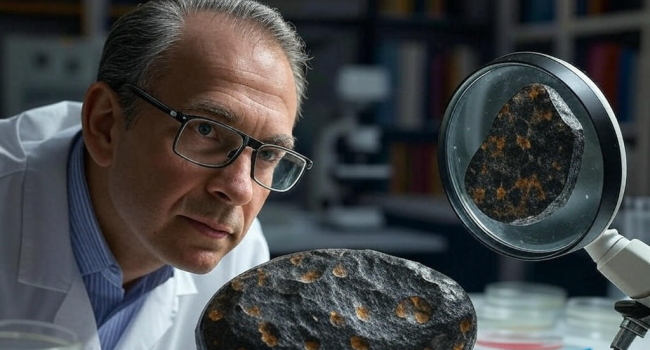
Researchers from Kobe University have finally cracked a puzzle that has baffled astrobiologists and planetary scientists for decades: why do carbonaceous meteorites appear less damaged than their non-carbonaceous counterparts? The surprising answer lies in explosive chemical reactions that blast away impact scars with hot gases, ejecting them into space. This discovery, published in Nature Communications, not only resolves a 30-year question but also sets the stage for future missions to the dwarf planet Ceres. Here’s how scientists reached this conclusion and what it means for space exploration.
The Mystery of Carbonaceous Meteorites
Meteorites, fragments of cosmic bodies, offer clues about the Solar System’s formation. Carbonaceous chondrites, rich in water and organic compounds, are especially valuable as the most ancient and primitive. Yet, scientists noticed something odd: unlike non-carbonaceous meteorites, these rocks show little evidence of shock metamorphism—structural changes caused by extreme pressure during high-speed collisions. It seemed as if carbonaceous meteorites experienced gentler impacts, but this defied logic: all meteorites in the asteroid belt endure similar collisions.
“I was intrigued by how meteorite materials change under impacts,” says astrophysicist Kosuke Kurosawa from Kobe University. “Why do carbonaceous meteorites look so ‘clean’? It was a challenge.”
The Experiment That Changed Everything
To investigate, Kurosawa’s team used a unique tool—a two-stage light-gas gun connected to a sealed chamber. This setup simulated high-speed impacts by firing projectiles at samples mimicking carbonaceous and non-carbonaceous meteorites. The chamber captured gases released during impacts, eliminating contamination from the gun itself, ensuring clean chemical data.
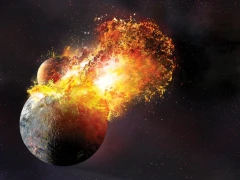
The results were striking: impacts on carbonaceous samples triggered reactions that produced hot carbon monoxide (CO) and carbon dioxide (CO₂) gases. These gases caused an explosion that ejected heavily damaged material into space. “The explosion is so powerful it literally blasts shocked rock away,” Kurosawa explains. Non-carbonaceous meteorites lacked these reactions, leaving their “scars” intact.
This explains why carbonaceous meteorites seem less damaged: impact traces aren’t erased—they’re physically removed, as if nature wipes away the evidence.
Ceres: Key to the Puzzle
Not all is lost for science. Kurosawa suggested that on larger bodies like the dwarf planet Ceres (939 km in diameter), gravity is strong enough to retain ejected material. The team’s calculations showed that on Ceres, shocked, carbon-rich debris could settle back onto the surface, forming deposits of high-energy fragments. “We predict Ceres holds traces of these powerful impacts,” Kurosawa says. “This makes it an ideal target for future missions.”
Ceres, located in the asteroid belt between Mars and Jupiter, was studied by NASA’s Dawn mission (2015–2018). The mission found salts, organic compounds, and evidence of liquid water on its surface, linking it to carbonaceous meteorites. Kobe’s discovery gives scientists a clear focus: search Ceres for debris ejected during ancient collisions, which may contain organic material or even biomarkers.
Connections to Other Discoveries
This finding resonates with other 2025 research:
- Lunar Soil: The Chang’e-6 mission revealed that rocks from the Moon’s far side contain water and mantle minerals, similar to carbonaceous chondrites. Gas explosions may have played a role there too.
- Evaporating Planet: Studies of BD+05 4868 Ab showed how gases form dust tails, a process akin to impacts on meteorites.
- Ryugu and Bennu: The Hayabusa2 and OSIRIS-REx missions confirmed that carbonaceous asteroids are rich in water and organics but fragile. Gas explosions explain why their fragments rarely reach Earth.
X users are thrilled: “Carbonaceous meteorites are like cosmic fireworks! Gas explosions carry their scars away.” Others joke: “xAI’s Grok is probably ready to analyze Ceres’ gases through an iPhone 17 camera!”
Why It Matters
The discovery reshapes our understanding of the Solar System’s history:
- Asteroid Evolution: Carbonaceous meteorites are as shocked as others; their damage is simply “hidden” in space or on bodies like Ceres.
- Search for Life: These meteorites may have delivered water and organics to Earth, as suggested by a Nature Astronomy study on chondrites. Gas reactions might have preserved molecules like hexamethylenetetramine.
- Missions: The findings will guide expeditions to Ceres, where shocked material could hold clues to life’s origins.
What’s Next?
Kobe’s team is collaborating with JAXA and Imperial College London to integrate these findings into mission plans. Ceres, with its deposits of salts and organics, is now a priority for studying ancient impact traces. Future probes, equipped with spectrometers like those on the James Webb Telescope, could analyze ejected material on-site. In 2026, JAXA’s DESTINY+ mission will study asteroids, potentially confirming Kurosawa’s theory.