make preferable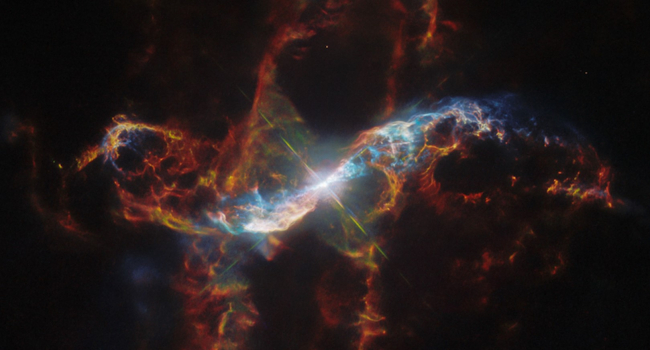
The Hubble Space Telescope has taken a close-up image of two stars near the constellation Aquarius that have been in close contact for centuries. The space telescope has shown the complex interaction of the star pair, reports Space.com.
The image shows a spectacular hourglass-shaped nebula formed by the centuries-old interaction of two stars: a compact, largely unchanged white dwarf (a hot burning star) and its companion star, a cool red giant that has grown in size and is now larger than the Sun by more than 400 times and which also changed its temperature and brightness 750 times during about 390 Earth days.
The white dwarf, which revolves around the red giant with an orbital period of 44 years, pours material onto its surface as it approaches, which is occasionally accompanied by an explosion like a "giant hydrogen bomb." As a result, curved streams of glowing gas are thrown into space. The exhaust is thrown into space at a speed of more than 1.6 million kilometers per hour. As an example, scientists note the distance from the Earth to the Moon, which this material travels in 15 minutes.
The process clearly shows how the universe redistributes thermonuclear fusion products that form deep within stars and are ejected back into space. And some of those products include heavier elements like carbon, nitrogen, and oxygen, which are the most important building blocks of planets like Earth.
As one of the closest symbiotic stars, R Aquarius has been studied extensively using various space and ground-based telescopes. For example, Hubble began studying it shortly after it was launched in 1990. A decade later, the Chandra X-ray Observatory began tracking changes in the nebula's X-ray emission, mainly emitted by its nodal jet and shock waves generated by R Aquarius as it collides with surrounding material. Based on these observations, astronomers suggest that the white dwarf last erupted in the late 1970s, and the next explosion could not occur until 2470 at the earliest.
The most recent Hubble image of this star system shows that the material ejected by powerful magnetic fields and the force of the explosion formed a spiral pattern and spread over 400 billion kilometers, 24 times the diameter of our solar system and the Hubble- , according to the team, is "truly incredible, even by astronomical standards." Time-lapse images taken over the past 10 years of R Aquarius show changes in the brightness of the stellar pair caused by the red giant's violent pulsations, as well as the dramatic evolution of the surrounding nebula.