make preferable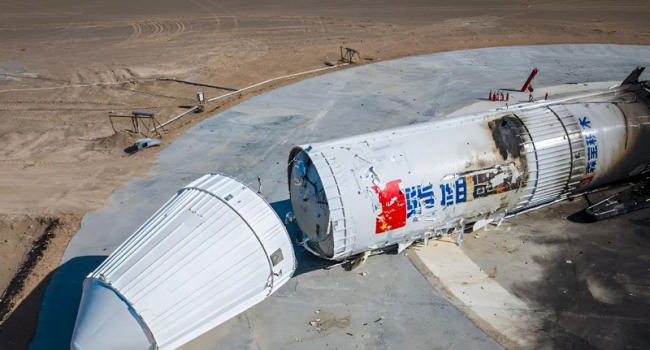
China's Deep Blue Aerospace test-fired the Nebula-1 reusable rocket on September 22. It successfully rose to the intended altitude and almost managed to land, but at the last moment it hit the ground and broke up. The entire flight was filmed from a drone.
The test launch of the missile was carried out from the Ejin Banner missile launch center in Inner Mongolia. The purpose was to test the performance of the Nebula-1 booster systems, as well as the ability of the first stage to return to Earth after disengagement from the second stage and to land with the engine on.
The rocket has a Leiting-20 engine that runs on kerosene and liquid oxygen. It can generate 20 tonnes of thrust at altitudes of less than 100m and is now moving to the next stage, flights up to 100km. The last flight of the rocket lasted 179 seconds and managed to achieve 10 of the 11 mission objectives. The last, the 11th, was the landing, which did not go as planned.
During the test, Nebula-1 was fired with all three engines, and when the rocket reached its intended maximum altitude, which was not specified, the other engines were shut down and the rocket was controlled by the central engine alone. Then Nebula-1 started to descend. the central engine reduced speed on approach to the landing site and then the accident occurred.
As the post-flight analysis showed, there was a failure in the missile control system. it performed a landing maneuver and cut off the engine while the missile was still in the air. As a result, Nebula-1 collided with the ground, but did not explode, probably because most of the fuel had already been used up by then. Deep Blue Aerospace said the test results will be taken into account during the next flight, which is scheduled for November.