make preferable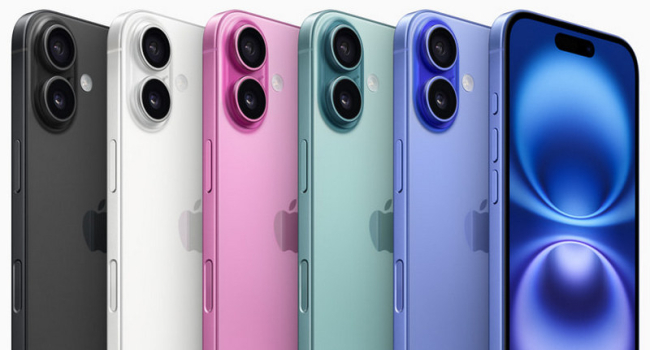
Apple held its “It’s Glowtime” event today, where it unveiled the iPhone 16 series of smartphones. In addition to the flagship iPhone 16 Pro and 16 Pro Max models, the basic iPhone 16 and iPhone 16 Plus were also introduced. The new models feature an updated design with fresh rear camera arrangements, new controls, and richer colors. Both the hardware and software have been upgraded, with much more AI integrated into the iPhone.
The design of the iPhone 16 largely mirrors that of the iPhone 15: flat edges, a glass back, the Dynamic Island cutout for the front camera and Face ID sensors, and a USB-C port for charging and data transfer. The iPhone 16 comes in five color options: black, white, pink, green, and blue, with the latter three being more vibrant than last year’s models. The return to vertically aligned rear lenses might seem like a strange callback to a design element Apple had abandoned, but this choice makes sense for improving support for spatial video, which can be viewed on the Apple Vision Pro.
The iPhone 16 now includes a new capacitive button on the side of the device, making photo and video capture easier. Apple calls it the “Camera Control” button. This button allows for smooth zoom control or shutter release and also offers access to Visual AI search and other Apple Intelligence features.
Apple's visual search feature, called Visual Intelligence, works directly on the smartphone. You can point the camera at any object, and the built-in neural network will identify it or provide a link. The same can be done with a math problem or text. If you point the camera at a poster, you can add the event to your calendar.

The iPhone 16 will be the first Apple smartphone to have full access to the beta version of Apple Intelligence after an update is released in October. With Apple Intelligence writing tools, users can adjust notes and emails to be more friendly or professional, check grammar and structure, and summarize text. In the Notes and Phone apps, you can record and transcribe audio as well as create conversation summaries. These text-editing tools are available almost everywhere users type. Apple Intelligence also helps prioritize notifications with summaries and the "Priority Messages" feature in Mail. Siri has received a new design and improved language understanding, allowing for more natural communication. Users can now combine voice input with typing, and Siri has expanded knowledge for answering questions.
Apple also announced that its Apple Intelligence AI functions will initially launch in the U.S. and in five other countries by the end of December: Australia, Canada, New Zealand, the UK, and South Africa. Next year, the AI will be available in China, France, Japan, and Spain, with the neural network learning the official languages of those countries.

As for the cameras, the iPhone 16’s dual-camera system includes a 48-megapixel main camera and a 12-megapixel ultra-wide camera with autofocus. It offers the “equivalent” of four lenses, thanks to 2x zoom on the main camera and macro mode on the ultra-wide lens. Apple has finally added the ability to pause video recording in the new iPhones.
According to Apple, the iPhone 16 uses the company’s toughest glass to protect the display from scratches. The iPhone 16 has a 6.1-inch screen, while the iPhone 16 Plus features a 6.7-inch screen, with no changes compared to their predecessors. However, the base models now offer a peak brightness of 2,000 nits and a minimum brightness of just 1 nit. Unfortunately, the refresh rate remains at 60 Hz.

The iPhone 16 also introduces the Action Button, which can launch the translator or voice recorder and previously was exclusive to the iPhone 15 Pro and Pro Max. It replaces the sound switch on the left side but can still perform its functions.
The iPhone 16 is powered by the new A18 chip, built using TSMC’s second-generation 3-nanometer process. The chip integrates two performance cores, four energy-efficient cores, a five-core GPU, and a 16-core neural engine capable of up to 35 TOPS. With the A18 chip, Apple is pushing Apple Intelligence — a set of AI features that work both on the device, thanks to the A18, and in the cloud through Apple Private Cloud Compute.

The A18 is 30% faster than the iPhone 15’s processor and consumes 30% less power, while the new GPU is 40% faster and uses 35% less power. As a result, the iPhone 16 offers a significant increase in battery life, according to Apple. The A18 also enhances gaming performance, enabling the iPhone 16 to support AAA games like Assassin’s Creed Mirage and Resident Evil 4, which were previously exclusive to the iPhone 15 Pro.
The new iPhone 16 is priced at $799 in the U.S. for the 128GB version, while the iPhone 16 Plus starts at $899. Sales begin on September 20, with pre-orders opening this Friday.