make preferable
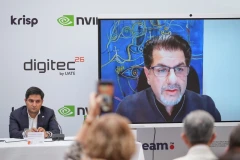
On October 14th at Silicon Mountains 2025 in Yerevan, Ucom, Armenia’s leading telecom provider, and Nokia, the Finnish tech giant, signed a game-changing deal. This isn't just another corporate handshake—it’s a bold step toward making Armenia a leader in next-gen connectivity with 6G, AI and other technologies of the future.
NEWS.am Tech sat down with Dr. Rolf Werner, Nokia's Senior Vice President and Head of Mobile Networks Europe, to discuss what this means for the region, the tech, and the people powering it. Spoiler: It's all about co-innovation, autonomous systems, and positioning Armenia as a digital powerhouse.
Why This Partnership Matters for Armenia and Beyond
Armenia might not be the first place you think of for cutting-edge tech, but Werner sees huge potential. Nokia, a global leader in 6G research, is bringing its expertise from projects in the U.S., Europe and other regions to Armenia.
“Having us here in Armenia is very important, not only for the country but also to demonstrate that Armenia can serve as a central hub for further development,” Werner told NEWS.am Tech. “Together with our partner Ucom, Nokia is very happy to further develop 6G and AI in Armenia.”
This partnership sets the stage for Armenia to attract investment and inspire innovation across the region. Werner compares Armenia to Switzerland: both are agile, educated, and quick to adopt new tech. He also points to Armenia’s strengths: a strong education system, top universities, and a talented workforce. With this deal, 6G and AI could spark a digital revolution in Armenia. For this the country is more than ready, Werner believes. Ucom’s 5G network already covers over 90% of the country—impressive even by Western standards.
This kind of coverage, according to Werner, puts it close to Western leaders like the UK or Germany, which hovers at 97-98%. Werner sees no major hurdles: with a focus on education—echoed by the Prime Minister’s mantra of “education, education, education”—plus low bureaucracy and Western orientation, Armenia is set to shine. Investments from companies like Synopsys are already boosting healthcare, IoT, and logistics.
Werner is noting Armenia’s unique speed and English fluency. “The speed that you apply here—and I’m, of course, referring to Ucom because we work closely with them—is just outstanding,” he said. “It’s not that I’m saying other countries don’t develop as fast, they do, and we see that. But in Armenia, especially with the great language skills you have here, you can be much more advanced. I do meet many more people speaking fluent English in beautiful Armenia than I see it in many other places. So, language is key. Language is definitely key, and once you know you can apply 6G, AI, any kind of digital possibilities you have in Armenia, this will definitely go into various directions.”
To become a regional innovation hub, Armenia should keep bureaucracy low, support telecoms like Ucom, and leverage its tight-knit decision-making culture. “You have a low distance between people who can really decide,” Werner noted.
Co-Innovation: The One-Word Mantra Driving 6G
When asked to sum up the partnership and its main goal in one word, Werner didn’t hesitate: “Co-innovate.”
“Co-innovation is the name of the game,” he said. “As with previous generations—3G, 4G, 5G, and now 6G—it takes about 10 years to develop. We're four or five years in, so until then, we must co-innovate to bring the right applications, approaches, and features for customers going forward. Co-innovation is really important.”
Nokia is leading the charge with projects like Hexa-X, a European initiative for 6G standards, and Sustain 6G, focused on sustainable networks. For Ucom, this means access to global expertise to build 6G that fits Armenia’s needs, from smart factories to consumer apps.
From 5G Strength to 6G Vision: Speed, Reliability, and… Sci-Fi Vibes
Ucom’s 5G network is already a standout, with Werner calling its 90%+ coverage “amazing, even compared to Western countries.” But 6G will take things further, creating networks that “sense, act, and feel.” Think tracking objects without devices or using AR glasses for new experiences.
“6G will offer additional possibilities for networks that sense, act, and feel,” Werner explained. “This means we may work in networks without devices, using glasses or tracking moving objects and subjects.”
While 5G powered industrial IoT, 6G will unlock features we can’t yet fully imagine. Nokia’s job, according to Werner, is to guide Ucom through this transition, ensuring smooth integration via global standards and partnerships.
For everyday users, 6G will mean smoother experiences, even in crowded settings like concerts or sports events. “An autonomous network manages traffic much better, improving latency and bandwidth management,” Werner noted. Expect faster uploads, seamless 8K streaming, and lag-free gaming, even when networks are packed.
Then there’s the futuristic stuff. Werner envisions gesture-based apps through AR glasses or goggles. “Imagine using WhatsApp by gesturing with your fingertip, seeing it scroll in front of you,” he said. Down the line, you might not even need glasses.
Does it sound like something from a sci-fi movie or book? “It’s not too far away,” Werner assured. “2030 will be the year of 6G implementation. And we have major parts of the technology already. For now, it's a question of standardization, it's a question of deployment and of course it's a question of investment. The companies so far are only amortizing the 5G investment, which is only like four five years ago. Let's face it. But going forward, you need to get ready for 6G. That's where we're so happy that we have signed today with Ucom the 6G agreement because you need to be ready for what's coming in four-five years. If you're not, you will never apply to the features and to the new development that's needed.”
Autonomous Networks: Smarter, Greener, Self-Healing
6G’s standout feature? Autonomous networks powered by AI. Today, network issues often need manual fixes, causing outages or dropped calls. With 6G, networks will “heal” themselves in real-time.
“In the future, we aim to achieve an autonomous network that automatically heals failure rates,” Werner said to NEWS.am Tech. “This will improve customer experience because automatic healing is much faster and more autonomous.”
These networks will also help save energy. In Yerevan, for example, networks could enter Nokia’s “extreme deep sleep mode” during low-traffic hours like 3-4 AM, cutting power use to nearly zero.
“An autonomous network learns from traffic patterns and adapts to the required level of performance,” Werner added.
In smart cities, 6G could enable cars to “talk” via AI-driven sensing, preventing accidents by spotting hazards like an oncoming vehicle around a curve. Sustainability and safety? That’s the 6G promise.
A Small Country to Inspire the World
Looking ahead, Werner is all-in on Armenia’s potential. “I’m 100% positive about Armenia,” he declared. Over the next 5-10 years, he sees the country leading the region, fueled by new investments and a stable political climate. “Armenia is ready for a lot of healthcare development. I see especially around IoT possibility, logistics because it’s central,” he said.
As 6G comes closer, Armenia's story could inspire the world: a small nation punching way above its weight in the tech arena.