make preferable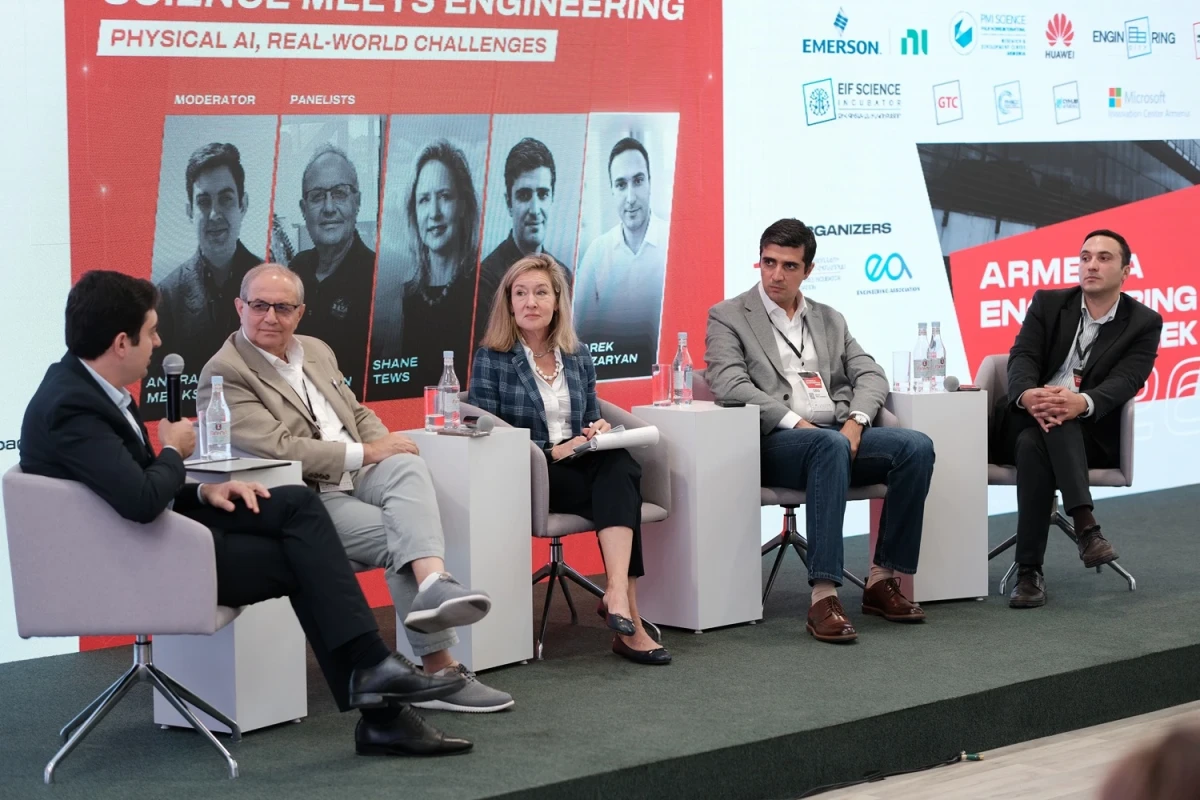
Physical AI has not yet had its own “ChatGPT moment” — the technology is still searching for its first truly mass-market application. But that is precisely why now may be the right moment for countries that do not want to merely catch up with an already established market, but to try to carve out their own place in it. At a discussion held as part of Armenia Engineering Week 2026, experts talked about the opportunities Physical AI could open up for Armenia — from developing its own scientific and engineering environment to automating agriculture, energy, and transport.
Not just users, but developers of the “intelligence layer”
One of Armenia’s advantages, the discussion participants said, is its strong tradition in the fundamental sciences.
According to Narek Nazaryan, scientific director of projects at the EIF Science Incubator and a researcher at Yerevan State University, the country could aspire to become a kind of hub for the “intelligence layer” of Physical AI. This means not only building the robots themselves, but also developing the algorithms and systems that allow physical devices to perceive the surrounding world and make decisions.
To achieve this, Nazaryan believes, it is not enough to develop science or engineering separately. What is needed is an environment in which scientists and engineers work together: rapidly building prototypes, testing them, encountering failures, and refining solutions.
According to him, institutions such as Engineering City and EIF are already trying to build such infrastructure in Armenia. Joint projects with industrial partners and grant programs focused on projects where the implementation of AI is a key part of the research are becoming additional tools.
In other words, the goal is not to create isolated projects, but an ecosystem in which new technologies can move more quickly from a scientific idea to a working prototype.
Armenia may have the advantage of small scale
Gurgen Mardoyan, head of R&D Armenia at PMI Science, suggested looking at Physical AI from another angle as well.
According to him, it is still too early to say with confidence which particular technology will become the main breakthrough. Today, there are already robots designed to work in homes, but the industry as a whole is still at the stage of searching for a truly mass-use case. In digital AI, the shift from experimentation to everyday use has already happened much more visibly, whereas for physical AI such a turning point still lies ahead.
That, Mardoyan believes, could become an opportunity for Armenia.
The country has a small population, and its growth is limited. But if Physical AI really makes it possible to automate a significant share of tasks, economic success in the future may depend less on simply increasing the number of people.
“If Physical AI works and if we really can use AI to do many things, perhaps we do not need to become a much more populous country in order to become very successful,” Mardoyan framed the opportunity in roughly these terms.
At the same time, in his view, this is not only about robots. The role of humans itself is changing: people need to learn how to assign tasks to AI, provide the system with the necessary context, verify the results, and supervise execution.
Mardoyan compared this to hiring a very smart specialist. Even if a person has enormous knowledge, you still need to explain what the company does, the competitive environment in which it operates, and exactly what is expected of them. Something similar happens with AI.
For Physical AI, this task becomes even more difficult: it is not enough simply to provide the system with information — it is necessary to formulate correctly what exactly it should do in the real world.
Therefore, the transition to Physical AI, Mardoyan believes, requires changes not only from the technologies themselves, but also from the people who use them. People need to learn how to work with AI, formulate tasks more precisely, and develop their own skills for interacting with such systems.
Armenia as a “sandbox” for new technologies
American technology policy expert Shane Tews pointed to another potential advantage for Armenia — the ability to test new solutions more quickly in real-world conditions.
According to him, physical systems differ from software primarily in that their behavior can be repeatedly tested under controlled conditions. If a system is supposed to perform a certain action, it can be tested a thousand or a million times to see how consistently it works.
But then a much more complicated challenge arises: interaction with people and with the real environment, whose behavior cannot be predicted in advance.
It is precisely here that Tews saw potential in Engineering City. In his view, the environment created there could become a kind of testing ground where developments can be checked step by step at different levels — from technical trials to use at a university, in manufacturing, or in a warehouse.
He compared this to the experience of South Korea, where, he said, some technological solutions could be tested and feedback obtained significantly faster than in the United States, thanks to the ability to concentrate on a specific task.
For Physical AI, this speed is especially important: a robot or another physical system must not only work well in a laboratory. It must be tested in an environment where people, equipment, unforeseen situations, and many other factors appear.
Where Physical AI could already be useful for Armenia in practice
NASA astrophysicist Vladimir Airapetian suggested looking not only at the possibility of developing Physical AI in Armenia, but also at the potential tasks this technology could solve within the country.
The first area he mentioned was the use of large territories. While traveling on the road from Yerevan to Gyumri, Airapetian noticed a large amount of uncultivated land. In the simplest scenario, he believes, Physical AI could be used to help turn such areas into land more suitable for development and use.
The second area is nuclear energy. Airapetian believes that physical systems with AI elements could be highly important in emergency situations at nuclear power plants, when the safety of the facility may depend on the speed of response. For a small country, a potentially serious accident could have especially large consequences.
Finally, he mentioned transport.
Airapetian pointed to the human factor behind the wheel and suggested that autonomous transport systems could, in the long run, reduce the number of accidents caused by human error.
This is another possible path for the development of Physical AI: not to create the technology in Armenia solely for entering the global market, but to use it to solve the country’s own problems.
The main advantage may turn out not to be in robots
At the same time, the discussion participants did not claim that it is already clear what the future of Physical AI will look like.
Mardoyan specifically warned against overly confident forecasts: according to him, the industry has not yet gone through its own “ChatGPT moment,” after which the technology becomes obvious to the mass user.
But it is precisely the absence of such a scenario for now that leaves room for experimentation.
For Armenia, this could mean an opportunity to simultaneously develop fundamental science, engineering competencies, and practical applications of the technology. Nazaryan is betting on collaboration between scientists and engineers, Tews on the ability to test developments quickly, Mardoyan on preparing people for a new form of working with AI, and Airapetian highlights several tasks where Physical AI could potentially benefit the country itself.
As a result, the question for Armenia is not only whether it will be able to create its own robots. Perhaps something else will prove more important: whether the country can create an environment in which physical AI can be quickly developed, tested, and turned into solutions for real-world tasks.
And if the mass-market scenario for Physical AI truly has not yet been defined, small countries may have a rare advantage — the opportunity not to wait until it takes shape somewhere else, but to try to shape their own.