make preferable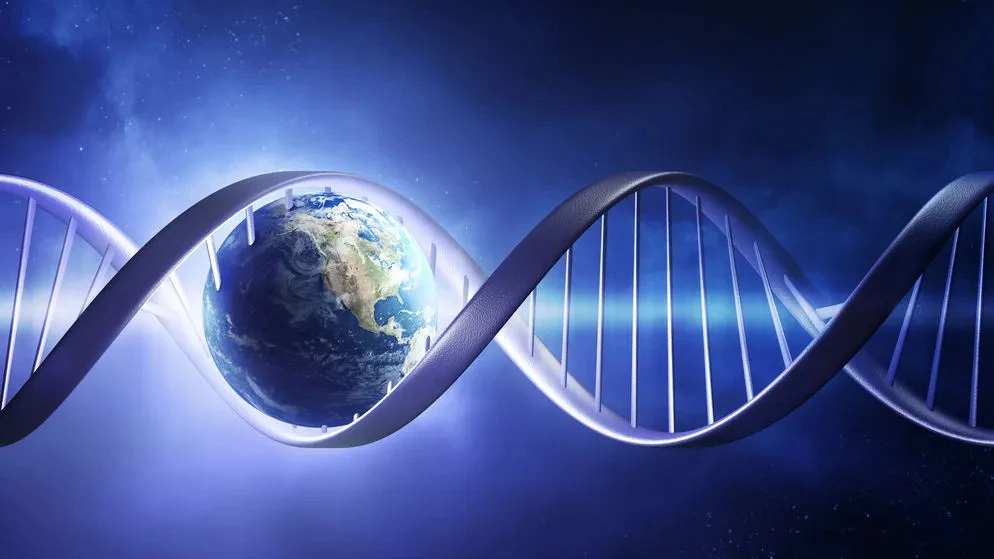
Around 4.33 billion years ago, two conditions necessary for the emergence of the first biological systems may have coexisted on the young Earth: a sufficiently stable environment and active sources of chemical energy. This conclusion was reached by scientists led by Oleg Abramov, a senior researcher at the Planetary Science Institute in the United States. Their study was published in Nature Communications.
Earlier, impacts regularly “sterilized” Earth
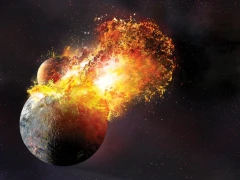
After its formation, Earth remained an extremely turbulent place. Asteroids, comets, and planetesimals constantly collided with the planet, heating and melting its surface. Such events could destroy the molecules necessary for the development of prebiotic chemistry.
The researchers created a three-dimensional model showing how the thermal state of Earth’s crust changed between 4.5 and 3.5 billion years ago. To do this, they used data from the lunar crater record and the content of highly siderophile elements in Earth’s upper mantle, as well as different estimates of the amount of material falling onto the planet.
They then compared the resulting temperatures with the stability limits of RNA and other molecules that may have participated in the chemical processes preceding life.
The model showed that until about 4.4 billion years ago, even a section of crust that had managed to cool could be reheated after another major impact. This posed a serious problem for prebiotic chemistry: molecules needed not just a brief window of suitable conditions, but a sufficiently long period of stability.
After 4.4 billion years ago, the situation began to change. Areas appeared in Earth’s crust that, once cooled, were no longer heated above the critical temperature. The authors called them “never-sterilized” regions.
The best conditions emerged around 4.33 billion years ago
The proportion of such stable areas gradually increased as the bombardment weakened. By 4.25 billion years ago, they already occupied more than half of the modeled crustal volume.
At the same time, scientists do not consider the impacts of asteroids and other bodies to be an exclusively destructive factor. After collisions, heat was retained in the rocks, and water passing through the heated and fractured rock could form hydrothermal systems.
Such systems combine several conditions that are potentially important for the emergence of life: liquid water, heat, and sources of chemical energy. Therefore, the decline in the intensity of global sterilization may have coincided with the persistence of local environments where chemically active processes continued.
It was precisely this combination that proved especially interesting to the researchers. Around 4.3 billion years ago, the model shows a large number of interconnected hydrothermal systems formed after impacts, while stable sections of the crust had already become widespread enough.
The “RNA world” may have gained the time it needed
One of the main candidates for the early stage of life’s emergence is the “RNA world” hypothesis. According to it, before the appearance of the modern system based on DNA and proteins, RNA molecules may have played the key role.
RNA is capable of both storing genetic information and participating in chemical reactions, including processes related to replication. But for such a system to arise and develop, it was not enough for suitable molecules to appear from time to time under favorable conditions. They needed to persist long enough, interact with one another, and take part in sequential chemical reactions.
That is why the researchers sought the moment when the destructive consequences of impacts no longer completely outweighed potentially favorable conditions.
According to Abramov’s team’s calculations, Earth may have become suitable for the very earliest stages of life roughly between 4.4 and 4.3 billion years ago. The optimal period turned out to be around 4.33 billion years ago — late enough for stable regions to appear on the planet, but still early enough for impacts by celestial bodies to continue creating numerous hydrothermal systems.
This does not mean that life actually originated at that exact time. The model identifies the period when the combination of conditions suitable for prebiotic chemistry could first have existed simultaneously on Earth. The exact moment when the first biological systems emerged remains unknown.