make preferable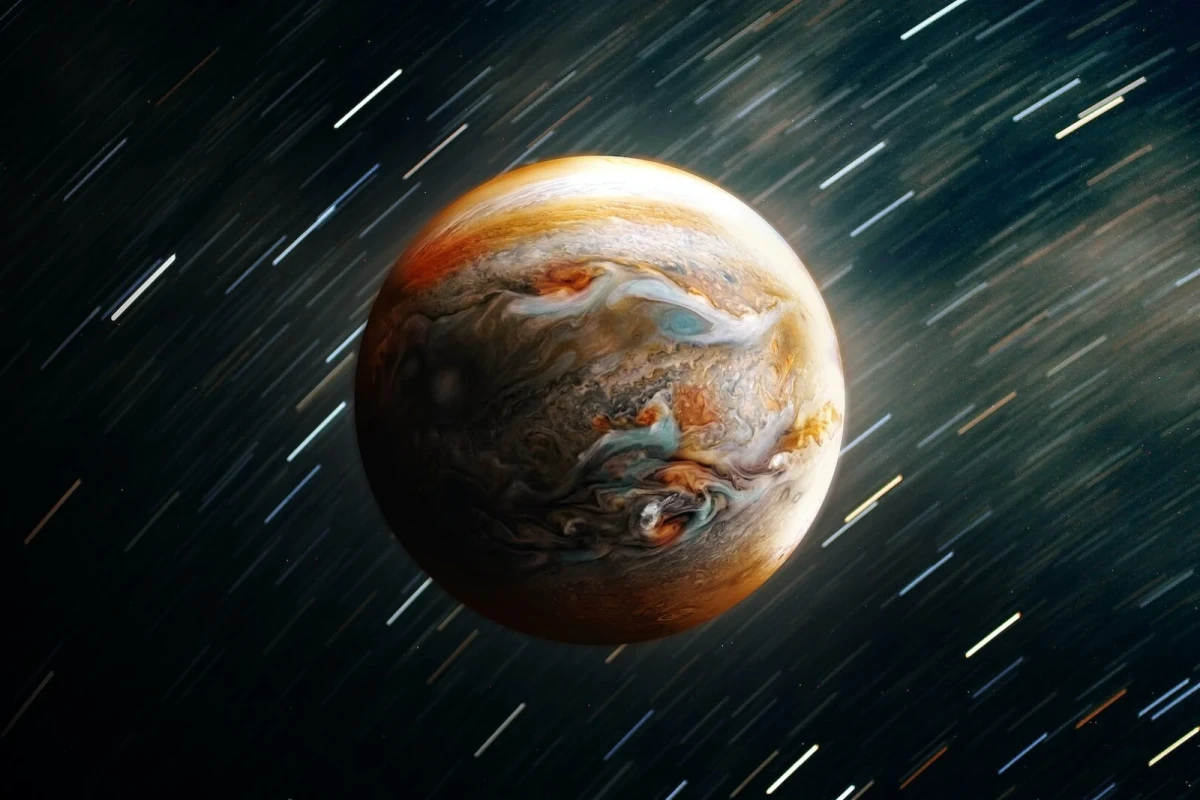
Astronomers have taken a small but important step toward one day learning how to forecast weather on planets beyond the Solar System. Using data from the James Webb Space Telescope, researchers identified the factors that drive atmospheric changes on the brown dwarf SIMP 0136, located about 20 light-years from Earth.
Scientists found that most of the observed changes can be explained by two parameters: temperature differences and changes in the vertical structure of clouds. Moreover, these factors persisted over several rotations of the object, even though the specific appearance of its atmosphere was changing.
A Brown Dwarf as a Laboratory for Studying Weather
SIMP 0136 is not formally an exoplanet. It is a brown dwarf — an intermediate type of object between planets and stars. Its mass is insufficient to sustain the thermonuclear fusion of hydrogen into helium that powers ordinary stars.
At the same time, in terms of their atmospheric properties, brown dwarfs can resemble giant exoplanets. There is also an important advantage: such objects can be observed directly, without waiting for rare transits across their host stars. That makes them convenient natural laboratories for studying complex atmospheric processes.
SIMP 0136 is especially interesting because its brightness changes slightly as it rotates. This means that different parts of its atmosphere take turns facing Earth, allowing astronomers to observe their features.
Scientists Identified Three Recurring Atmospheric States
The researchers applied principal component analysis to the observations — a mathematical method used to identify the main patterns in a complex dataset and separate them from less significant variations.
The analysis showed that changes in SIMP 0136’s brightness can largely be described by three recurring weather states.
In some regions, the atmosphere was hotter and the cloud layer was thinner. In colder regions, by contrast, the clouds became denser and extended higher into the atmosphere.
This is an important result for the future study of weather on distant worlds: instead of treating every change in brightness as a separate phenomenon, scientists can identify a few main processes that shape the observed picture.
The Weather Changes, but the Physical Rules Remain
However, identifying recurring states is not enough for forecasting. To make predictions, it is necessary to confirm that the atmosphere truly behaves according to the same rules over time.
That is exactly what the researchers found in SIMP 0136. The main factors driving weather changes remained consistent over more than a dozen rotations of the object, although the specific structure of its atmosphere had time to change during that period.
“We also found that these factors behind the weather changes on SIMP 0136 persist over time, even as the detailed appearance of the atmosphere changes over more than a dozen rotations,” said lead author Merle Schrader, a doctoral student at Trinity College Dublin.
It is, in a way, a situation familiar to meteorologists: the specific weather keeps changing, but the main mechanisms that shape it remain stable.
A True Forecast Is Still a Long Way Off
The new method still cannot tell us what the temperature or cloud conditions on SIMP 0136 will be tomorrow. However, it could significantly speed up the first stage of studying an alien atmosphere.
Instead of immediately running complex and resource-intensive computer models, scientists will first be able to identify the main factors responsible for the observed atmospheric variability. Those data can then be used for more detailed modeling.
“Applying this technique to a wide range of brown dwarfs and giant exoplanets will help us better understand the diverse weather systems shaping worlds far beyond our Solar System,” noted co-author Johanna Vos of Trinity College Dublin.
The study was published on September 16 in the journal Astronomy & Astrophysics. True “weather forecasts” for exoplanets are still a long way off, but astronomers are gradually learning to distinguish random changes in their atmospheres from stable patterns — the first necessary step toward future space meteorology.