make preferable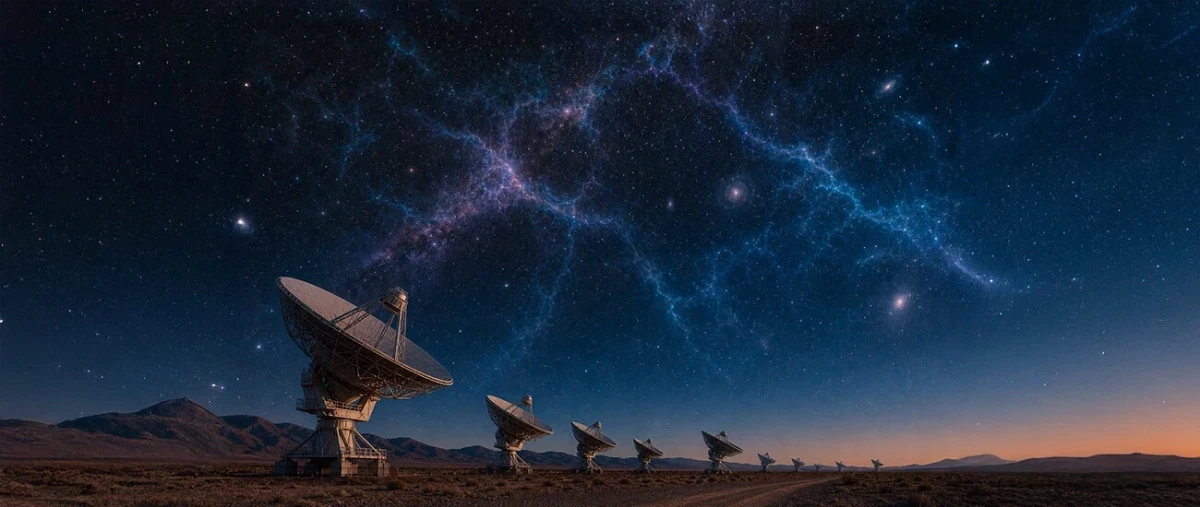
Astronomers using the MeerKAT radio telescope have, for the first time, confidently isolated a signal from neutral hydrogen originating from an epoch when the Universe was several billion years younger than it is today. The detection opens the door to a new method of mapping the large-scale structure of the cosmos—so-called hydrogen intensity mapping.
How Distant Hydrogen Is "Seen"
Neutral hydrogen emits a faint radio signal at a wavelength of 21 centimetres. As the Universe expands, this signal is stretched—this is the redshift effect. The amount of redshift reveals how long the radiation has been travelling and to which epoch the emitting gas belongs.
The method of hydrogen intensity mapping does not require detecting each galaxy individually; instead, it measures the cumulative signal from hydrogen over vast volumes of space. In this way, scientists obtain a three-dimensional picture of matter distribution in the Universe. Until now, such studies typically combined radio data with optical galaxy surveys. The new work demonstrates that a map can be constructed primarily from MeerKAT's radio observations alone.
What Was Achieved
The team analysed about 96 hours of observations from the South African MeerKAT array, which consists of 64 antennas. They managed to extract the hydrogen signal that had been travelling to us for 4 to 5 billion years. The structures in which this gas is distributed extend over many millions of light-years—a scale comparable to the distance between the Milky Way and the Andromeda galaxy.
"This is a very important milestone," said team leader Surabh Paul. "Hydrogen intensity mapping has long been considered a promising way to efficiently map the Universe, but the signal is extremely weak and difficult to separate from background radiation, terrestrial interference, and instrumental effects. This direct detection with MeerKAT shows that the method is becoming a practical tool for cosmology."
Why This Matters
Neutral hydrogen is a key element for understanding how galaxies form and evolve. By measuring its collective signal, astronomers can study both galaxy evolution and the overall distribution of matter, without spending time on detecting each individual object.
The success is particularly encouraging in light of the construction of the Square Kilometre Array Observatory (SKAO) in Australia and South Africa. MeerKAT serves as one of the precursors to this giant instrument, and the fact that the faint signal could be extracted even from 2018 data—when the array was just beginning its scientific work—speaks to the great potential of already accumulated observations.
In the future, the team plans to process more extensive and longer MeerKAT observations to build more detailed hydrogen maps and better understand how the largest structures of the cosmos have evolved over billions of years.
In Brief
Using the MeerKAT radio telescope, astronomers have isolated a neutral hydrogen signal from 4 to 5 billion years ago and demonstrated the feasibility of mapping the Universe's large-scale structure through 21‑cm intensity mapping. The method measures the cumulative emission from gas over vast volumes of space without the need to detect each galaxy individually. The result is important for future surveys involving the Square Kilometre Array and for studying galaxy evolution and matter distribution.