make preferable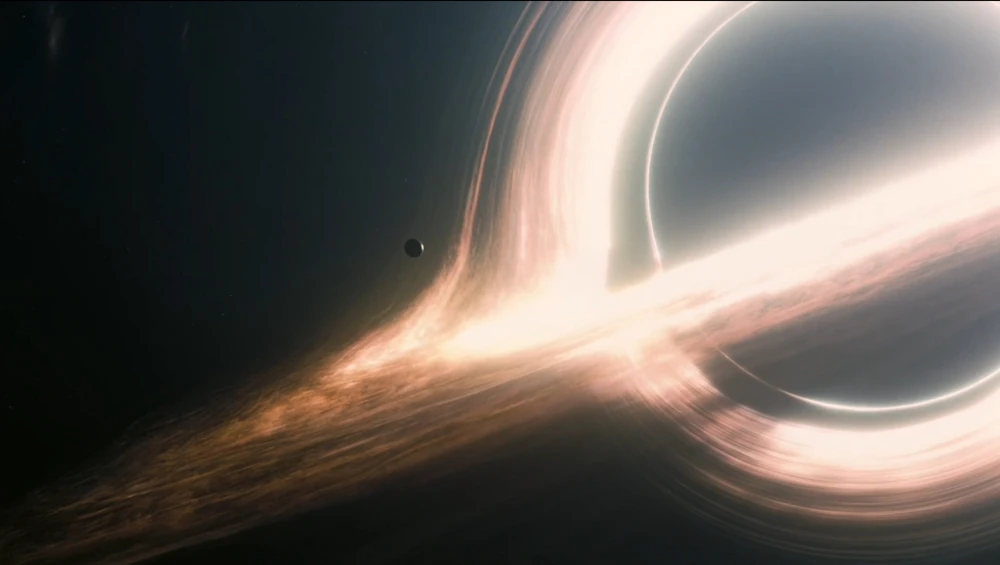
Black holes possess monstrous density. Vyacheslav Avdeev, a researcher at the Astrospace Center of the Lebedev Physical Institute of the Russian Academy of Sciences, explained just how compact objects become when compressed to a black‑hole state.
Earth the Size of a Cherry
According to the scientist, a black hole with the mass of Earth would be roughly the size of a cherry. He also gave a larger example for comparison. If the Sun were compressed into a black hole, its diameter would be about six kilometres—meaning a radius of roughly three kilometres.
Earth's mass exceeds 5.97 sextillion tons (5.97 × 10²¹ tons). The Sun's mass is about 1.99 octillion tons (1.99 × 10²⁷ tons). The difference in mass is enormous, yet both bodies, in their black‑hole states, turn out to be extremely compact.
Why This Happens
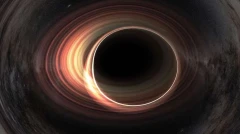
A black hole is a region of spacetime with such strong curvature that nothing can escape it. Even the speed of light is insufficient to overcome this warping. The event horizon is considered the conventional boundary: the surface beyond which nothing can ever emerge. Yet a black hole has no physical "wall" or solid surface.
It is precisely the extreme concentration of mass in a tiny volume that creates such curvature. Hence, an object with the mass of an entire planet can fit within the size of a small fruit.
In Brief
Astrophysicist Vyacheslav Avdeev noted that a black hole with Earth's mass would be roughly the size of a cherry. The Sun, in the same state, would shrink to a diameter of about six kilometres. Such dimensions are explained by extreme density: mass is concentrated in a minuscule volume, creating a curvature of spacetime from which even light cannot escape.