make preferable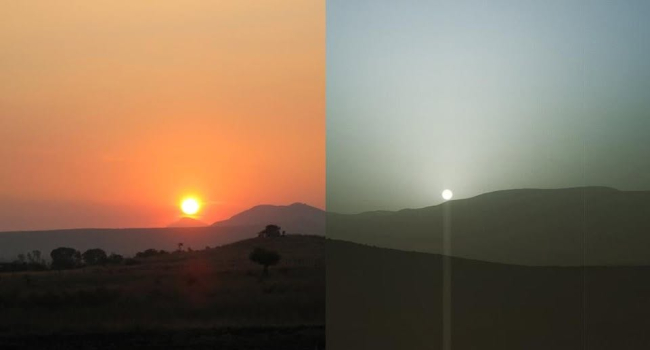
On Earth, sunsets are associated with red, orange, and golden hues. On Mars, this familiar picture changes: as the Sun sinks toward the horizon, the sky around it takes on a bluish tone. At the same time, Mars remains the "Red Planet"—and it is the dust in its atmosphere that creates both of these visual effects simultaneously.
Humanity captured its first photos of a Martian sunset back in 1976 thanks to the Viking 1 lander. Since then, various rovers and landers from NASA have repeatedly photographed sunrises and sunsets, gradually helping scientists understand why the Martian sky looks so different from Earth's.
The Sun looks smaller on Mars
Mars is farther from the Sun than Earth, so from its surface, the Sun appears about one-third smaller than it does to us on Earth.
However, the size of the solar disk is far from the main difference. What is much more interesting is what happens to sunlight as it passes through the Martian atmosphere.
The atmosphere of Mars is much thinner than Earth's, but it contains a large amount of tiny dust particles. It is these particles that determine much of what a spacecraft's camera sees—and what a human standing on the surface would see.
Why the sunset turns blue
Mars is called the Red Planet because of the iron oxides in its soil—essentially a kind of Martian "rust." During the day, this dust gives the surrounding landscape a characteristic reddish-yellow tint.
At sunrise and especially at sunset, however, the picture changes.
Fine dust particles in the atmosphere interact with sunlight in such a way that the blue part of the spectrum penetrates the atmosphere slightly more effectively. The scattered blue light remains closer to the direction of the Sun, while yellow and red light scatter more widely across the rest of the sky.
As a result, a blue glow appears around the setting Sun, while the rest of the sky may retain yellow and orange tones.
This is why a Martian sunset looks almost like the opposite of an Earthly one: on Earth, sunsets are typically red, while on Mars, they are blue.
The first Martian sunsets
The first sunset viewed from the surface of Mars was captured by Viking 1 in August 1976. The camera took the image about 15 minutes before sunset in the Chryse Planitia region.
The Sun's low position above the horizon revealed surface features that were not visible in photos taken when the Sun was higher in the sky. The image showed depressions in the terrain, large rocks, and areas of exposed bedrock.
At the same time, the shadows appeared blurry. The reason was that same Martian dust: as sunlight travels a long path through the atmosphere at a low angle, it scatters off dust particles.
What modern rovers saw
Since Viking 1, dozens of spacecraft have photographed the surface of Mars. Each has added something new to our understanding of Martian sunrises and sunsets.
In November 2021, Perseverance captured a sunset using its Mastcam-Z camera system. During this period, there was relatively little dust in the atmosphere, so the blue hue of the sunset was less pronounced than usual.
In February 2023, Curiosity captured so-called crepuscular rays—rays of light passing through clouds after sunset—more clearly than ever before. This phenomenon is familiar on Earth, occurring when sunlight passes through gaps in clouds or other obstacles in the atmosphere.
For Mars, this observation was particularly interesting because it allowed scientists to study clouds and the movement of light through the atmosphere in greater detail.
Sunrises look unusual too
Martian sunrises are also very different from those on Earth.
In 2019, the InSight lander photographed a sunrise at around 5:30 AM local Martian time. Even earlier, in 1978, Viking 2 captured a sunrise in the Utopia Planitia region.
Such photos usually turn out quite dark. The brightest area of the sky is immediately above the Sun. Light is scattered and partially absorbed by the tiny dust and ice particles suspended in the atmosphere.
Twilight on Mars can last for hours
Another feature of Martian sunsets and sunrises is prolonged twilight.
Scientists found that a faint glow can remain visible long after the Sun has set and can appear well before it rises. In some cases, twilight lasts up to two hours.
This is due to dust suspended at high altitudes. Even after the Sun has dipped below the horizon for an observer on the surface, its rays continue to illuminate dust particles in the upper layers of the atmosphere. These particles scatter light toward the night side of the planet, creating a long-lasting twilight glow.
On Earth, a similar effect is sometimes observed after powerful volcanic eruptions, when vast quantities of fine particles are thrown high into the atmosphere.
Beautiful photos help study the atmosphere
Martian sunsets interest scientists not just because they look unusual.
By analyzing the nature of the twilight glow, researchers can determine how high dust rises into the atmosphere. These observations also help detect clouds made of dust and ice particles and allow scientists to study the overall properties of the Martian atmosphere.
Through the color of the sky, the intensity of the light, and the duration of twilight, scientists gather valuable data about atmospheric processes on Mars.
And herein lies one of the most intriguing paradoxes of the Red Planet: the very same dust that turns Mars red transforms its sunsets into blue.
Based on materials from NASA Science