make preferable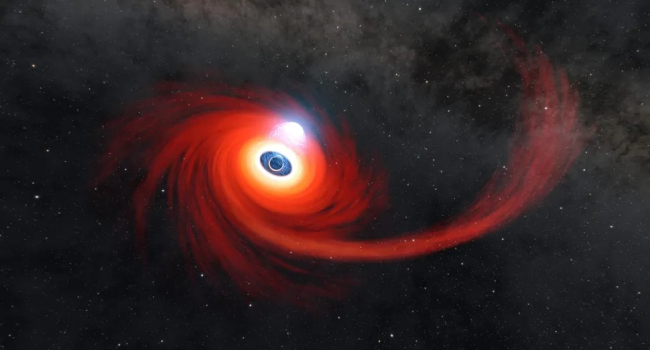
Astronomers have discovered the most distant known object of the "black hole–star" type. It existed less than 660 million years after the Big Bang and provides an important clue to understanding the mysterious "little red dots" that the James Webb Space Telescope regularly finds in the early Universe.
What a black hole–star is
According to current understanding, the little red dots are growing supermassive black holes surrounded by dense gas clouds. These clouds shine in such a way that the object's spectrum resembles that of cool red stars, such as red giants. Many of these objects lie at the centres of young galaxies, whose light has travelled to us for about 12 billion years.
The new object, named MoM‑BH*‑1, was discovered as part of the Mirage or Miracle (MoM) programme. It is considered the best example of a "naked" black hole–star: astronomers are reasonably confident that it exists in isolation, rather than inside an already formed galaxy. All of the object's light is produced by matter accreting onto the black hole at the centre of a gas cloud.
"The spectrum we recorded is our best evidence for a gas envelope feeding an early forming black hole," noted Rohan Naidu from the University of Hawaii, who led the team that discovered the object.
The connection to the little red dots
MoM‑BH*‑1 lies close to a young galaxy at the same redshift. Estimates suggest that in about 100 million years, the black hole–star will collide and merge with this galaxy. Modelling has shown that after the merger, the system's spectrum would closely resemble the spectra of the already known little red dots found inside galaxies.
"If we treat the black hole–star as a template for the black hole component in the little red dots, it helps clarify many uncertainties. Once embedded in similar host galaxies, such objects could serve as the central 'engines' of young quasars," explained Jorrit Mattei from the Institute of Science and Technology Austria.
Why this matters
One of the main scientific goals of the James Webb Space Telescope is to understand how supermassive black holes managed to grow so quickly in the early Universe and whether they preceded their host galaxies. The new data support a scenario in which black hole–stars play a key role in the earliest stages.
"Astronomers have never lacked imagination: ever since the discovery of quasars, there has been no shortage of theories about how these black holes grew so fast. Something dramatic must have happened in the early Universe. Now, with JWST, we can directly observe that era," Naidu said.
The study was published on 13 August in the journal Nature.
In brief
Astronomers have found the most distant known black hole–star, MoM‑BH*‑1, which existed less than 660 million years after the Big Bang. The object is likely not part of a galaxy and provides the best confirmation yet of the model explaining the mysterious little red dots seen in JWST images. After merging with a neighbouring galaxy, such a system would look exactly like a typical red dot. The work was published in the journal Nature.