make preferable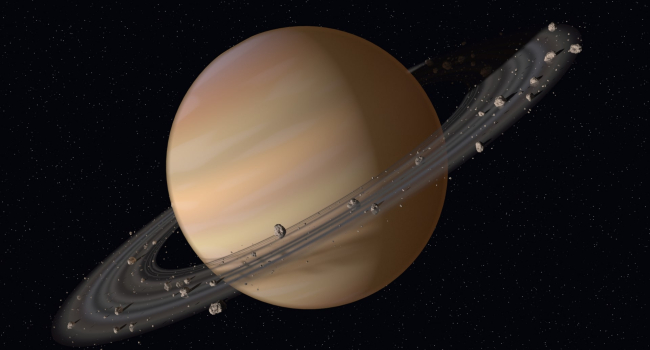
Scientists analysing data from the Cassini mission have uncovered an unusual detail in the structure of Saturn's magnetosphere—the planet's protective magnetic bubble. The discovery shows that the magnetospheres of gas giants form differently from Earth's. The work is published in Nature Communications.
What a magnetospheric cusp is
The solar wind is a stream of charged particles flowing from the Sun. A planet's magnetosphere shields its atmosphere from this flow. Near the poles, funnel‑shaped gaps exist—these are magnetospheric cusps. Through them, solar wind particles can penetrate directly into the atmosphere.
The Cassini spacecraft explored the Saturn system from 2004 to 2017. Scientists examined data from the 2004–2010 period and determined the position of the planet's cusp.
How Saturn differs from Earth
On Earth, the cusp is typically located close to the noon side. The shape of Earth's magnetosphere is determined by the balance between solar wind pressure and the planet's own magnetic field. Earth's day lasts 24 hours, and its rotation is relatively slow.
On Saturn, it is different. The day there lasts only about 10.7 hours. The planet's rapid rotation effectively "drags" the cusp away from noon: on average, it is shifted toward the afternoon side—typically between 13:00 and 15:00 local time, and sometimes reaching 20:00.
Furthermore, Saturn's magnetosphere contains large amounts of ionised material originating from its moon Enceladus. The rotating disk of this material, together with the magnetic field, balances the solar wind pressure and shifts the cusp toward the afternoon and evening side.
Why this matters
The location of the cusp influences models of magnetic reconnection, particle acceleration, and auroras on Saturn.
"This result allows us to move forward in developing new theories about how planetary magnetospheres interact with the solar wind," noted study co‑author Dr. Lisha Ray of Lancaster University.
The discovery confirms that a planet's rotation rate and the composition of its near‑space environment can significantly alter the structure of its surrounding space.
In brief
Cassini data have shown that Saturn's magnetospheric cusp is shifted toward the afternoon side due to the planet's rapid rotation and the influence of material from Enceladus. This fundamentally distinguishes the gas giant's magnetosphere from Earth's. The finding helps us better understand how planets interact with the solar wind. The work is published in Nature Communications.