make preferable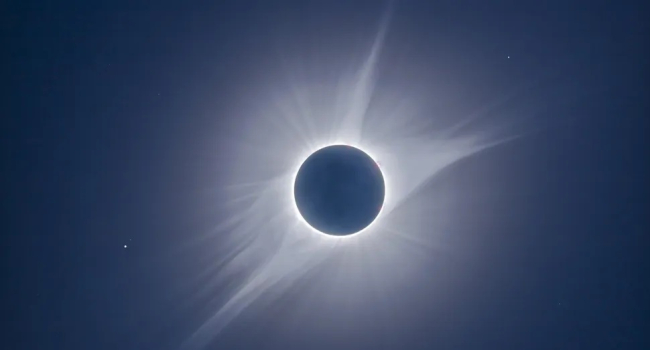
Every total solar eclipse is unique. The Moon's silhouette hardly changes, but when it fully covers the Sun's disk, for a few minutes the corona—the Sun's outer atmosphere—becomes visible. It is its delicate white rays and intricate structure that drive eclipse chasers to travel the world, Space.com reports.
Why the corona is always different
The corona is created by superheated plasma, which is held and shaped by the Sun's magnetic field. Because the magnetic field is constantly changing, the corona is never the same. It evolves from year to year, from month to month, and even from day to day.
"The Sun follows a natural 11‑year cycle of rising and falling activity," explained solar physicist Ryan French from the Laboratory for Atmospheric and Space Physics. "At the peak of the cycle, known as solar maximum, the Sun has many sunspots. They generate flares and coronal mass ejections. At minimum, these phenomena are almost absent."
During minimum, the corona appears more symmetrical, with long wing‑like streamers on either side. At maximum, it becomes complex, almost like a five‑pointed star, with many rays emanating from active regions.
What the corona will look like in 2026
The 12 August eclipse will occur not at the peak of Solar Cycle 25—which came in October 2024—but about two years after it, during the declining phase. However, activity declines gradually, and the Sun will still be noticeably more active than in 2017–2020.
The projected sunspot number for August 2026 is about 102. That is lower than the April 2024 figure of around 144, but still high enough for a fairly complex and asymmetrical corona. Observers will likely see prominent streamers, but without the extreme "starburst" structure of solar maximum.
What else can be spotted
During totality, bright pink or magenta prominences often appear—giant structures of hydrogen plasma suspended by magnetic fields. Since the Moon will be only slightly larger than the solar disk, small prominences from different sides may be visible simultaneously.
In theory, a coronal mass ejection (CME) could also be seen during an eclipse, but that would require considerable luck. Such events last for hours, so during the brief totality (maximum 2 minutes 18 seconds), only a snapshot of an already‑occurred ejection is likely to be captured.
A moment that will never repeat
The exact configuration of the corona on 12 August 2026 will never recur. It will reflect the specific state of the Sun's magnetic field on that day. After totality ends, that view will vanish forever.
The eclipse will be visible along a path crossing Greenland, Iceland, Spain, and the Balearic Islands. For those who find themselves in the right place under clear skies, this will be a rare opportunity to witness the Sun's corona with their own eyes.
In brief
The total solar eclipse on 12 August 2026 will reveal a unique structure of the solar corona, shaped by the current state of the Sun's magnetic field. The eclipse occurs during the declining phase of Solar Cycle 25, so the corona will be more active than at minimum, but calmer than in 2024. Observers can expect to see streamers and possibly bright prominences. This particular view of the corona will never be seen again.