make preferable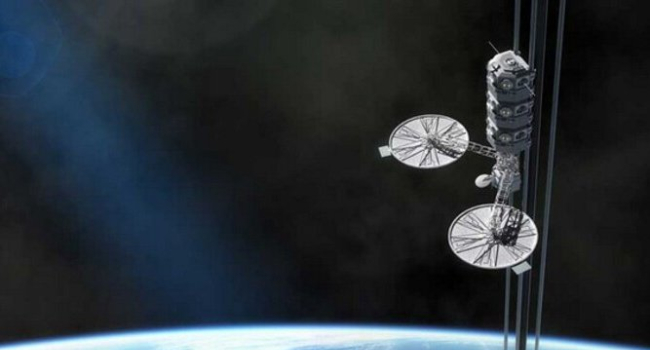
The space elevator is one of the most ambitious engineering ideas of the future, capable of completely changing the way we explore space. Unlike rockets, which require huge amounts of fuel and place a significant strain on the environment, a space elevator is designed to become a more efficient system for delivering cargo and people into orbit.
The idea consists of creating a giant cable connecting the surface of Earth to a space station in geostationary orbit. Special lifting vehicles—so-called "climbers"—will be able to move up and down this cable, delivering equipment, materials, and passengers.
Just a few decades ago, such a project was considered virtually impossible. The main problem was the lack of a material that would be both light enough and incredibly strong to support a structure tens of thousands of kilometers long.
The situation changed in 1991 when carbon nanotubes were discovered—a material with a unique combination of low mass and high strength. They are considered one of the prime candidates for creating the space elevator cable.
How a space elevator works
The foundation of the system will be a geostationary station located approximately 36,000 kilometers above the equator. In this orbit, a satellite rotates at the same speed as Earth, making it appear stationary to an observer on the surface.
From this station, a cable will be extended simultaneously downward to Earth and upward into space. The upper section of the structure will be equipped with a counterweight to help maintain the balance of the entire system.
Special transport platforms—climbers—will move along the cable. They will be able to transport people and cargo without the need to launch rockets for every flight.
One of the most famous space elevator projects was developed by the Japanese corporation Obayashi Corporation. According to their concept, the total length of the structure should be about 96,000 kilometers.
Cities and stations on the way to space
The project involves building an entire infrastructure around the space elevator.
On Earth's surface, an Earth Port will be constructed as the main departure and arrival hub. It will consist of two parts: land-based and offshore.
The land-based section will essentially become a space city, housing control centers, a major airport, hotels, research institutes, and aerospace industry enterprises.
The offshore section will be built on a floating platform in the ocean near the equator. It will accommodate key technical facilities: arrival and departure gates for climbers, repair hangars, warehouses, administrative buildings, and research centers.
The platform will have a circular shape with a diameter of about 400 meters. Its stability will be provided by a hollow concrete structure relying on buoyancy. If necessary, the platform can be relocated, and cable tension will be adjusted using a seawater ballast system.
Space stations and centers on the Moon and Mars
One feature of the project is the ability to create intermediate stations with different gravity levels.
For example, at an altitude of about 3,900 kilometers, a center with Martian-level gravity could be built. Another station at roughly 8,900 kilometers would simulate lunar gravity.
Such facilities will allow research, astronaut training, and preparation for future expeditions to other planets.
At an altitude of about 23,750 kilometers, a dedicated hub is planned to interact with low Earth orbit. From there, satellites can be sent into orbits around 300 kilometers above Earth.
The project also provides for placing large solar power stations in space. They will harness solar energy without losses caused by the atmosphere and beam power down to Earth.
Gateway to the Solar System
A space elevator can serve not only as a transit system around Earth, but also as a launching point for journeys to other planets.
Beyond geostationary orbit, stations are planned for planetary exploration and resource extraction.
At an altitude of about 57,000 kilometers, a "Mars gate" could be established—a departure point for spacecraft heading to the Red Planet. The space elevator's upper counterweight could also serve as a base for launching probes to Jupiter and asteroids.
Thanks to Earth's rotational speed, spacecraft launching from these altitudes will find it significantly easier to escape Earth's gravitational field.
How the space elevator will be built
Construction of this giant structure will begin by delivering necessary materials to low Earth orbit using rockets.
Then, a construction vehicle with an electric engine will gradually ascend to geostationary orbit while deploying the cable. Approximately eight months after launch, the cable will reach Earth's surface, and the vehicle at an altitude of 96,000 kilometers will serve as the counterweight.
After that, reinforcement of the structure will begin. Special construction climbers will ascend the initial cable, installing additional strengthening elements.
After about 500 reinforcement cycles, the system will be ready to carry cargo and passengers.
Each transport vehicle is expected to weigh around 100 tons. They will be used to assemble the main geostationary station and the rest of the infrastructure.
Geostationary station: A city in space
The main space elevator station is envisioned as a true space settlement.
It will be used for scientific research, manufacturing in microgravity, solar energy collection, and space tourism.
The station's structure will consist of numerous identical modules about 10.8 meters long. This design allows elements to be easily transported, expanding the station or replacing damaged parts.
During transit, modules will fold compactly into a triangular prism shape. Upon reaching orbit, they will expand using compressed air, growing roughly sixfold into hexagonal structures.
Inside the station, an atmosphere similar to Earth's will be maintained, though due to the lack of gravity, inhabitants will experience weightlessness.
When the space elevator will appear
Despite the project's massive potential, many challenges must be solved before realization. The main ones include developing an ultra-strong cable made of carbon nanotubes, creating reliable climbers, and ensuring overall system safety.
However, if these technologies are successfully developed, construction could take around 25 years. According to predictions by concept developers, full operation of the geostationary station could begin around 2050.
The space elevator remains a project for the future, but its creation could mark one of the most important milestones in human history—a transition from an era of individual spaceflights to a permanent human presence beyond Earth.
Based on materials by Obayashi