make preferable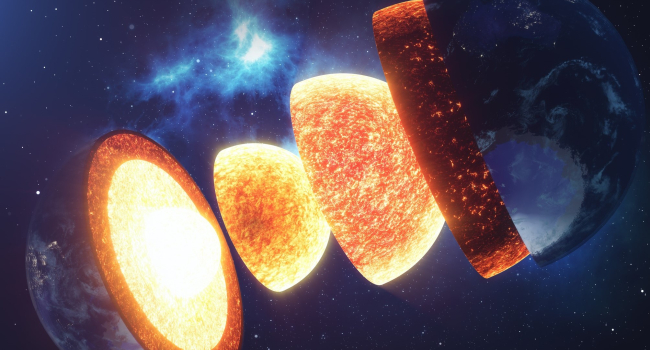
The familiar model of planetary structure — a dense metallic core, a silicate mantle, and a thin atmosphere — may actually be the exception rather than the rule. According to a new study, most rocky and intermediate-sized exoplanets could have a completely different internal structure.
The research, published as a preprint on arXiv and submitted to The Astrophysical Journal, challenges long-standing assumptions about the composition of the most common planets in the Universe.
Sub-Neptunes and super-Earths — the Galaxy’s most common worlds
Most discovered exoplanets belong to the sub-Neptune class — larger than Earth but smaller than Neptune. Their close relatives, super-Earths, are somewhat smaller and have usually lost much of their hydrogen.
Until now, scientists generally assumed that these planets formed in much the same way as Earth, differing mainly in the amount of gas in their atmospheres.
However, under the extreme pressures and temperatures inside such planets, matter behaves very differently from how it does on Earth.
Hydrogen and silicates can mix together
At temperatures above roughly 4,000 K, hydrogen and molten silicates stop separating and become completely miscible — similar to how salt dissolves in water. Iron also mixes into this blend.
As a result, if a planet captures more than about 1% of its mass in hydrogen, its interior may transform into a homogeneous, churning liquid composed of iron, silicates, and hydrogen.
In that scenario, there is no clear metallic core or silicate mantle in the traditional sense.
The authors of the study noted that the familiar concept of a planetary core — a small, dense metallic heart — may actually be more unusual than typical.
A new explanation for old mysteries
The model helps explain several puzzling features of exoplanets that have long challenged astronomers, including:
- the “radius gap” — the strange shortage of planets of intermediate size between super-Earths and sub-Neptunes;
- the relationship between planetary radius and orbital period.
According to the new theory, young sub-Neptunes retain a significant amount of hydrogen within their mixed interior layers and gradually release it into the atmosphere as they cool.
In effect, hydrogen slowly “boils out” of the rocky material over hundreds of millions of years.
How the theory could be tested
The model makes a testable prediction: young sub-Neptunes should cool more slowly and appear more “inflated” than classical models predict.
Astronomers are now beginning to discover such planets around very young stars only tens of millions of years old. Observations from James Webb Space Telescope and future missions may allow researchers to test the hypothesis directly.
Is Earth the unusual planet?
If the new model is correct, then Earth’s familiar layered structure may actually be relatively rare.
The most common planets in the Galaxy could instead consist internally of a uniform mixture entirely unlike our own world.
Of course, the study is based on theoretical calculations describing matter under extreme conditions that are difficult to reproduce experimentally. Still, the model aligns well with accumulated observational data.
In brief
A new study suggests that most sub-Neptunes and super-Earths — the most common types of planets in the Galaxy — may lack the familiar metallic core and silicate mantle found on Earth. With sufficient hydrogen, materials inside the planet may mix into a single homogeneous liquid layer. The model offers a better explanation for several observed exoplanet properties, including the radius gap. If correct, Earth’s classical layered structure could make it an unusual planet rather than a typical one.