make preferable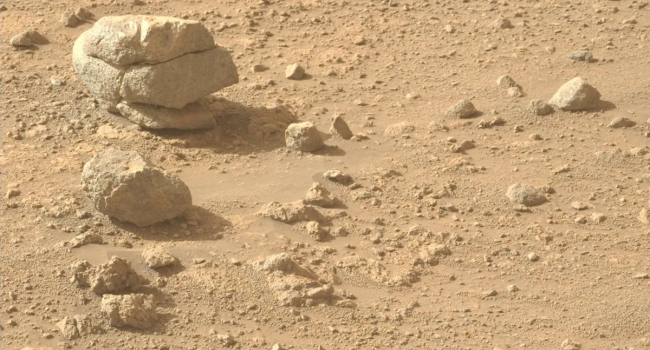
NASA’s Perseverance (rover) has discovered an unusual formation on the surface of the Red Planet — several rocks neatly stacked on top of each other. The image immediately sparked questions and jokes online: “Who’s stacking rocks on Mars?”
What Perseverance saw
As reported by Space.com, the image was taken on May 13 (Sol 1859 — a Martian day) using the Mastcam-Z camera mounted on the rover’s mast. The photo clearly shows three rocks placed one on top of another, resembling a sandwich in the middle of a dusty reddish landscape.
Such rock “cairns” are familiar to Earth hikers, who sometimes build them as trail markers. On Mars, however, where no human has yet set foot, the formation appears especially intriguing.
Natural or artificial?
Most likely, this is the result of natural processes. Scientists suggest that it may be a single larger rock that broke apart over time and took on this shape due to wind erosion or ancient water flows.
According to data from another rover, Curiosity (rover), the main geological force shaping Mars today is wind. Over hundreds of millions or even billions of years, it gradually erodes rocks and landscapes.
Not the first “strange” rock
The Martian surface has puzzled scientists and the public many times before. Rovers have found spherical stones, perfectly aligned fragments, striped rocks, and even an object that in 1976 some interpreted as the “Face on Mars” in images from the Viking mission.
Each of these discoveries tends to spark conspiracy theories, but the real explanations are usually far more interesting. Studying such formations helps scientists better understand Mars’ geological history, its past climate, and the processes that shape its surface.
Importantly, no humans have ever been to Mars, so the idea of a “tourist stacking rocks” can be ruled out.
In brief
The Perseverance (rover) captured an unusual stack of rocks on Mars that looks artificially arranged. Scientists believe it is most likely the result of wind erosion or ancient water activity that fractured and repositioned a single rock. The finding once again highlights how nature can create strange and deceptive shapes, helping researchers better understand the geological history of the Red Planet.