make preferable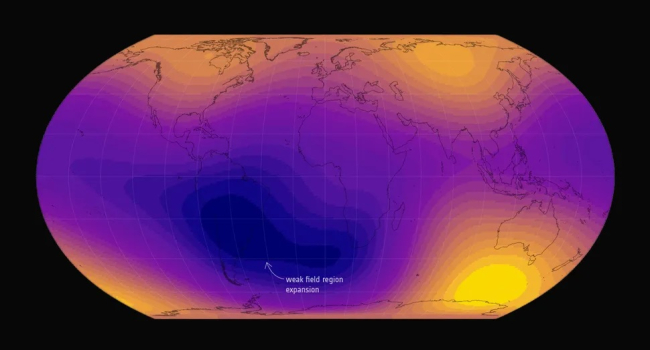
A weak region in Earth’s magnetic field, known as the South Atlantic Anomaly, has expanded over the past decade to cover an area roughly half the size of continental Europe. This conclusion comes from data collected over eleven years by the Swarm satellite constellation of the European Space Agency (ESA). Since 2014, Swarm has been monitoring this region, and new research indicates that the anomaly has not only spread eastward but has also begun weakening more rapidly since 2020, according to a report by Space.com.
What is happening inside the anomaly?
According to Chris Finlay, professor of geomagnetism at the Technical University of Denmark and lead author of the study, the magnetic field behaves differently over Africa than it does over South America, suggesting that something unusual is occurring in that zone, causing the field to weaken more intensely there. Geological evidence suggests that the anomaly has existed for about 11 million years, but its effects became noticeable only during the space age.
Earth’s magnetic field shields satellites and the International Space Station (ISS) from charged particles carried by the solar wind, which can damage onboard electronics or disrupt communications with Earth. In the region of the South Atlantic Anomaly, however, this protection is much weaker, increasing the risk of radiation exposure for spacecraft.
The cause of the anomaly: irregularities in Earth’s core
Earth’s magnetic field is generated by the movement of molten iron within its core, creating powerful electric currents that extend far into space. Scientists have identified unusual magnetic patterns in the area between the liquid outer core and the solid mantle, where the magnetic field behaves in unexpected ways. Finlay explained that beneath the anomaly, researchers have found zones where magnetic field lines, instead of emerging outward from the core, turn back toward it. Swarm data indicate that one such area is drifting westward beneath Africa, intensifying the anomaly’s weakening effect.
Other changes in the magnetic field
Swarm’s observations also reveal that the magnetic field is not merely weakening—it is undergoing complex regional shifts. Over Siberia, it has strengthened across an area roughly the size of Greenland, while a strong magnetic zone over Canada has shrunk by almost the size of India. Furthermore, since the mid-19th century, the magnetic north pole has been moving from Canada toward Siberia, a shift that could affect navigation systems such as compasses.
The role of the Swarm mission
Finlay emphasized that Earth’s magnetic field is far more complex than a simple dipole, like that of a bar magnet. Only satellites like Swarm can provide a complete map of its structure and track how it changes over time. The three Swarm satellites, launched in November 2013 from Russia’s Plesetsk Cosmodrome, have provided the longest continuous dataset on Earth’s magnetic field ever gathered from space, offering valuable insights into the planet’s intricate magnetic dynamics.
In summary
The South Atlantic Anomaly, a weak zone in Earth’s magnetic field, has grown over the past ten years and has been weakening more rapidly since 2020. This poses increased radiation risks to satellites and the ISS. Swarm data reveal strange magnetic patterns in Earth’s core and a westward drift of the anomaly toward Africa. While the field has strengthened over Siberia, it has weakened over Canada, and the magnetic north pole continues its steady shift toward Siberia. The Swarm mission may hold the key to understanding these evolving magnetic changes.