make preferable
The 2025 Nobel Prize in Physics was awarded to John Clarke (UK), Michel Devoret (France), and John Martinis (USA) for their groundbreaking work in quantum physics. They developed devices that became the foundation of superconducting qubits — the core elements of quantum computers. Their experiments in the 1980s demonstrated that quantum effects, normally observable only at the atomic level, can also appear in macroscopic systems such as electrical circuits. This was explained to Gazeta.Ru by Stepan Lisovsky, Deputy Director of the PhysTech School of Electronics, Photonics, and Molecular Physics.
Quantum Effects: From Atoms to the Macroworld
Quantum mechanics traditionally describes the behavior of particles at the microscopic scale — for example, how electrons can “tunnel” through barriers. In the ordinary macroscopic world, however, these effects are typically lost due to chaotic interactions between countless particles.
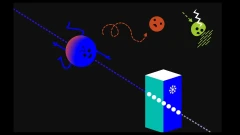
The laureates proved the opposite: in superconductors — materials that conduct electricity without resistance at low temperatures — billions of particles can behave as a single entity, displaying distinct quantum properties.
“Imagine road traffic,” Lisovsky explained. “If every driver acts independently, traffic jams occur. But if all cars move in perfect sync, the flow becomes smooth and fast. The same happens in superconductors: electrons act in coordination, moving without friction.”
In 1984–1985, the scientists created superconducting circuits that quantized energy, meaning they absorbed or emitted it in fixed amounts — exactly as predicted by quantum mechanics.
A Breakthrough for Technology
According to Stanislav Straupe, scientific director of Sber’s Quantum Technology Center, the laureates showed that quantum effects can occur in large, visible objects, such as microscopic aluminum structures. Their work laid the groundwork for superconducting qubits, the fundamental units of information in quantum computers.
These computers already exist: IBM and Google use them, and similar research is being carried out in Russia at MISiS, Bauman Moscow State Technical University, and Moscow Institute of Physics and Technology (MIPT).
These discoveries pave the way for new technologies — quantum cryptography, ultrasensitive sensors, and powerful quantum computers capable of solving problems that are beyond classical systems — from molecular modeling to logistics optimization.
In Short
The 2025 Nobel Prize in Physics was awarded to John Clarke, Michel Devoret, and John Martinis for demonstrating quantum effects in macroscopic superconducting circuits — the precursors of modern qubits used in quantum computers. Their discoveries from the 1980s made quantum technologies a reality, and similar research is now actively conducted in Russia’s MISiS and MIPT.