make preferable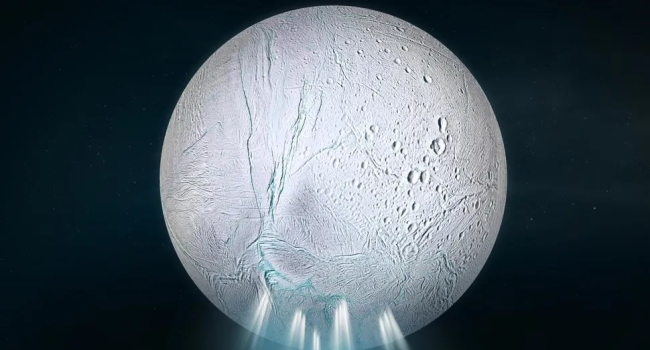
An analysis of archival data from NASA’s Cassini mission, which ended in 2017, has led to a sensational discovery: complex organic molecules have been detected in the water plumes of Enceladus, Saturn’s moon. These molecules, containing carbon, may be part of a chain of chemical reactions that could lead to the emergence of life. The findings were published on October 1 in Nature Astronomy.
Discovery of Plumes and Their Origin
In 2005, Cassini discovered powerful eruptions of water vapor from giant fissures on Enceladus’s surface, known as “tiger stripes.” These cracks are thought to be linked to a subsurface ocean within the moon, which is about 500 km in diameter. Some of the geyser material falls back to the surface as snow, while much of it is ejected into space, forming Saturn’s diffuse E ring.
New Evidence: Organics from the Ocean
A team led by Nozair Khawaja of the Free University of Berlin and the University of Stuttgart reanalyzed data collected in 2008 by Cassini’s Cosmic Dust Analyzer (CDA). Their analysis revealed previously unnoticed organic molecules in the icy particles of the plumes.
Khawaja explained that numerous organic molecules had already been detected in the ice grains of Saturn’s E ring, including amino acid precursors. However, because these ring particles are exposed to radiation from Saturn’s magnetosphere, it was unclear whether the molecules originated from Enceladus’s ocean or were formed in space.
Unlike the E ring particles, which travel at around 12 km/s and undergo radiation alteration, the plumes eject material at about 18 km/s, allowing scientists to capture “fresh” particles unaffected by space radiation. The new analysis confirmed that the same organic molecules found in the E ring also exist in the plumes, along with additional ones: aliphatic compounds, (hetero)cyclic ethers/alkynes, ethyl ethers, and possibly nitrogen- and oxygen-containing compounds. On Earth, such molecules take part in reactions leading to the building blocks of life.
The Mystery of Origin: Ocean or Surface?
The discovery strongly suggests that the detected molecules originate from the subsurface ocean rather than being products of space radiation. However, research by Grace Richards of the National Institute for Astrophysics and Planetology (INAF) in Rome highlighted a possible complication: radiation on Enceladus’s surface, especially near the “tiger stripes,” could also generate organic molecules. If so, some of the compounds in the plumes may have formed on the surface before being carried upward, making it harder to determine their true source.
Khawaja added that many chemical pathways from the detected molecules to biologically relevant compounds are possible, which increases the likelihood of Enceladus being habitable.
The Future: A Mission to the Surface
To definitively answer the question of the molecules’ origin, direct measurements are needed. The European Space Agency (ESA) is considering a mission with an orbiter and lander, potentially arriving at Enceladus by 2054. Only the analysis of fresh surface ice will confirm whether the moon’s ocean contains chemistry capable of sustaining life.
In Brief…
Enceladus’s geysers contain complex organic molecules, identified in 2008 Cassini data. These compounds, including aliphatic and nitrogen-bearing molecules, most likely come from the moon’s subsurface ocean, boosting the case for habitability. However, surface radiation may complicate interpretation. An ESA mission planned for around 2054 could finally determine whether Enceladus’s ocean harbors the ingredients for life.